

Managing High Indoor Humidity When Your AC is Already Running Full Time
Dropping the thermostat in July won't fix that cold, clammy feeling. See why an oversized air conditioner leaves you shivering yet sticky, and what it takes to actually remove the moisture.
The July Struggle: Why Your Home Feels Cold and Clammy
Managing high indoor humidity when your AC is already running full time is one of the most frustrating challenges a homeowner can face during the peak of summer. At Supreme Heating and Cooling, our team fields countless calls every July from local homeowners dealing with this exact issue. July in Pennsylvania brings a very specific type of weather. The air in the Pittsburgh river valleys gets heavy, muggy, and thick with moisture. When that intense humidity creeps indoors, your first instinct is likely to walk over to the thermostat and drop the temperature a few more degrees. You hear the system kick on, you feel the cold air blasting from the vents, but an hour later, you are still uncomfortable. The house feels like a refrigerator, yet your skin feels sticky, and the air feels damp.
This is the classic "cold and clammy" effect. It happens because lowering the thermostat actually makes high indoor humidity feel significantly worse. Cold air cannot hold as much moisture as warm air, so as the temperature drops without the moisture being removed, the relative humidity in your living space spikes. You are left shivering while still feeling sticky. Before you keep fighting a losing battle with your thermostat, it is critical to address your indoor air quality directly.
Homeowners dealing with July peak summer humidity in Pennsylvania eventually reach a decision point. You must choose between making minor HVAC operational adjustments, investing in whole-home dehumidifiers, or bringing in a professional to evaluate if your current air conditioning unit is simply oversized for your square footage. Understanding the connection between true indoor comfort and proper moisture extraction is the first step toward getting your home feeling right again.
Sensible vs. Latent Heat: What Your Air Conditioner is Actually Doing
To understand why your home feels so damp, our technicians often have to explain the physics of residential cooling to our customers. An air conditioning system is tasked with managing two completely different types of heat: sensible heat and latent heat. Most homeowners only think about one of them, but true comfort requires addressing both simultaneously.
Sensible heat is the thermal energy you can actually measure with a standard thermometer. It is the raw temperature of the air. When your thermostat says the room is 78 degrees and you want it to be 72 degrees, you are asking the air conditioner to remove sensible heat. The system absorbs this heat from your indoor air and exhausts it outside.
Latent heat, on the other hand, is the thermal energy trapped within the moisture suspended in the air. Water vapor holds a massive amount of heat energy. This is what makes a humid 80-degree day feel suffocating, while a dry 80-degree day feels perfectly pleasant. When your air conditioner removes latent heat, it is pulling that suspended moisture out of the air, condensing it into liquid water, and draining it away.
The 15-Minute Rule of Moisture Extraction
Here is the mechanical reality that causes so many problems: an air conditioner is very good at dropping sensible heat quickly, but it is slow to remove latent heat. When your system turns on, the indoor coil gets extremely cold. It takes time for the warm, humid air blowing across that coil to reach its dew point and start leaving condensation behind.
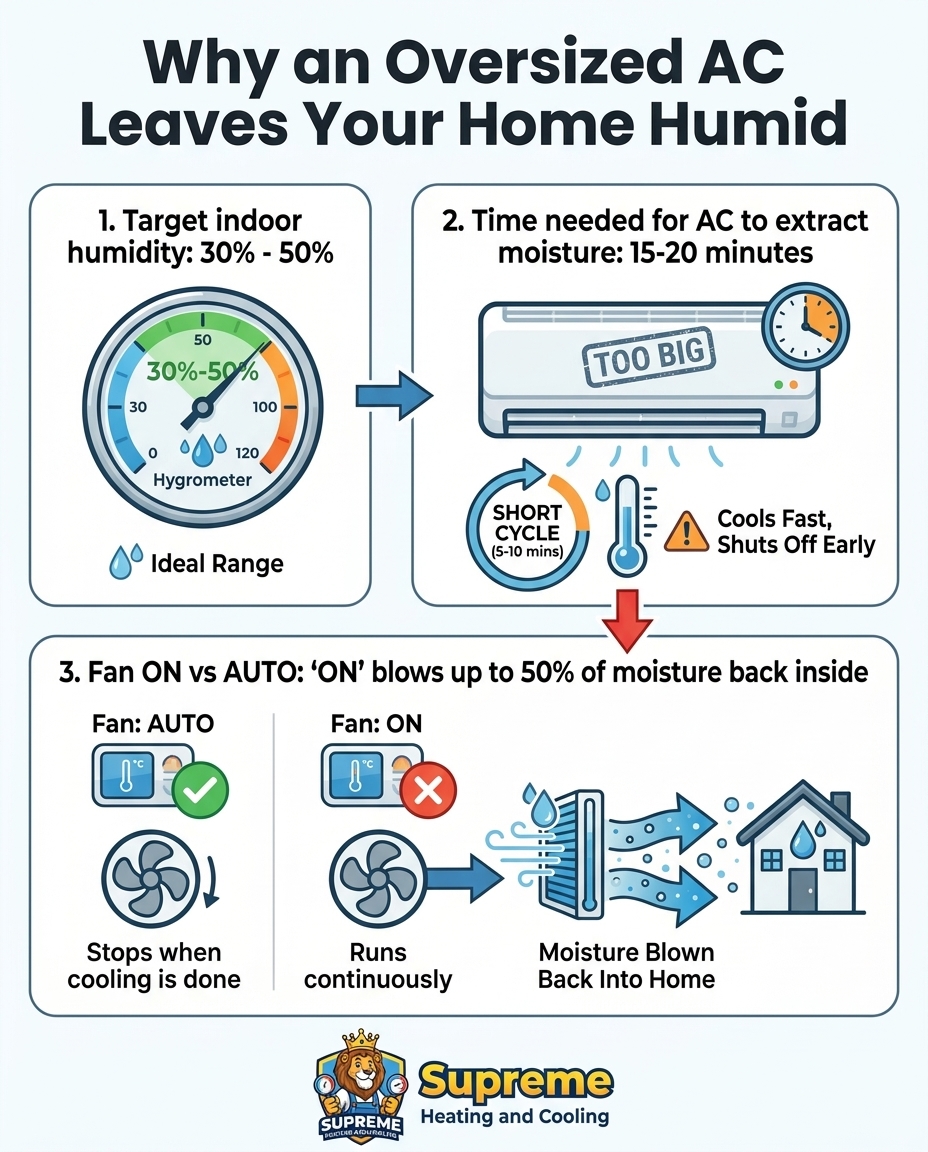
Typically, an air conditioner needs to run consistently for 15 to 20 minutes before it effectively begins extracting latent heat from the air in meaningful volumes. If the system shuts off before that 20-minute mark, it has cooled the air (removing sensible heat) but left the moisture behind (failing to remove latent heat). This is exactly why your AC struggles to cool during July heatwaves and leaves you with high indoor relative humidity despite cold thermostat settings.
• Sensible Heat — What It Measures: Air Temperature — How It Affects Comfort: Determines if you feel hot or cold — AC Runtime Required: Drops almost immediately when AC starts
• Latent Heat — What It Measures: Air Moisture (Humidity) — How It Affects Comfort: Determines if you feel sticky or dry — AC Runtime Required: Requires 15-20+ minutes of continuous runtime
The Short-Cycling Trap: Why Bigger Isn't Better for AC Units
One of the most common misconceptions our installers encounter in the HVAC industry is that a larger air conditioning unit will perform better and cool a house faster. While a massive unit will certainly drop the air temperature in a hurry, it creates a severe operational problem known as "short-cycling." Short-cycling is the primary reason homes end up feeling cold and clammy.
When an AC unit is oversized for the square footage and heat load of a home, it blasts an overwhelming amount of cold air into the living space. The thermostat, which is only measuring sensible heat (temperature), registers that the target temperature has been reached in just five or ten minutes. Satisfied, the thermostat shuts the system down.
The Sponge Effect on Your Evaporator Coil
Think of your indoor evaporator coil like a sponge trying to soak up water from a flooded floor. If you only leave the sponge on the floor for a few seconds before pulling it away, it will barely absorb anything. Because the oversized AC unit shuts off in under 15 minutes, the coil never gets the chance to act as a dehumidifier. The air gets cold fast, but the moisture stays suspended in the rooms.
As the cold air sits in the house, the relative humidity spikes. The system then stays off until the temperature slowly creeps back up, at which point it blasts cold air for another brief cycle. This rapid on-and-off cycling not only fails to remove humidity, but it also causes extreme wear and tear on the compressor and drives utility bills through the roof. The system is consuming massive amounts of startup electricity without ever doing the hard work of latent heat extraction.
At Supreme Heating and Cooling, our technicians see this short-cycling pattern constantly on summer service calls. In our experience working across Pittsburgh's unique climate, we know that equipment must be meticulously matched to the home's actual heat load. A correctly sized unit will run in long, steady cycles. It might take longer to drop the temperature initially, but by running continuously, it pulls gallons of water out of the air, balancing both temperature and humidity perfectly.
Thermostat Mistakes That Trap Moisture Indoors
Not every humidity problem requires a mechanical overhaul. When our team responds to a muggy home complaint, the very first thing we check is how the system is being controlled. Homeowners often make well-intentioned adjustments at the thermostat that inadvertently trap moisture inside, leading directly to high indoor relative humidity despite cold thermostat settings.
The Environmental Protection Agency (EPA) recommends keeping indoor relative humidity between 30% and 50%. When levels push past 60%, the air feels heavy, and the environment becomes hospitable to mold and mildew. To keep your levels in the safe zone during peak summer heatwaves, avoid these common thermostat mistakes that we see all too often:
1. Setting the fan to "ON" instead of "AUTO": This is the single biggest user error when it comes to indoor humidity. When your fan is set to "ON," the blower motor runs 24/7, even when the outdoor compressor has shut off. While the compressor was running, it pulled moisture out of the air, leaving the indoor coil dripping wet. If the fan keeps blowing after the cooling cycle ends, it sweeps across that wet coil, re-evaporates the water, and blows up to 50% of that condensed moisture right back into your living room. Always keep the fan set to "AUTO" during the summer.
2. Cranking the temperature drastically lower: When the house feels sticky, the natural reaction is to drop the thermostat from 74 degrees down to 68 degrees. This forces the system to overcool the air. While it does force the unit to run longer, it drops the sensible temperature so low that the relative humidity feels even worse. You end up wearing a sweater in July while the air still feels damp.
3. Using extreme setback temperatures while away: If you turn your AC off or set it to 85 degrees while you are at work to save energy, the house absorbs massive amounts of latent heat all day. When you return at 5:00 PM and set it back to 72 degrees, the system has to work for hours just to catch up on the sensible heat, often struggling to extract the heavy moisture load that baked into your furniture and carpets all afternoon. Keep temperature setbacks mild (no more than 3 to 5 degrees) to maintain moisture control.
Hidden Culprits: Ductwork, Coils, and Airflow Issues
If your thermostat is set correctly and your unit is properly sized, but you are still battling July peak summer humidity in Pennsylvania, the problem likely lies within the mechanical components of the HVAC system itself. Over time, wear and tear, neglected maintenance, or hidden structural issues can severely cripple an air conditioner's ability to extract latent heat.
When our Supreme Heating and Cooling technicians investigate a home struggling with chronic humidity, we look for several specific mechanical failures that bridge the gap between simple settings and complex repairs. Keeping up with routine AC maintenance is the best way to prevent these hidden culprits from taking hold.
• Dirty evaporator coils acting as an insulator: The indoor coil needs direct contact with the warm air passing over it to transfer heat and condense moisture. If the coil is covered in a layer of dust, pet hair, or grime, that dirt acts as an insulating blanket. The air never touches the cold metal, meaning the moisture cannot condense. The system will run constantly, but the water will stay in the air.
• Leaky return ductwork pulling in unconditioned air: The return ducts pull air from your living spaces back to the air handler to be cooled. If these ducts run through an unconditioned attic, a humid crawlspace, or a hot garage, and they have leaks or disconnected seams, they will suck in heavy, humid outside air. Your AC is essentially trying to dehumidify the outdoors, which is an impossible task.
• Low refrigerant levels altering coil temperatures: Refrigerant is the lifeblood of the cooling process. If your system has a small leak and the refrigerant charge drops, the pressure inside the evaporator coil changes. This can cause the coil to become too cold, freezing the condensation into ice rather than letting it drip down the drain pan. A frozen coil blocks airflow entirely and stops all dehumidification.
• Clogged condensate drain lines: As the AC extracts water from the air, that water drips into a pan and flows out through a PVC pipe. If algae or sludge clogs that pipe, the water backs up into the pan. The standing water sits inside the air handler, and the blower fan simply evaporates it and pushes the humidity right back into your ductwork.
Finding the Right Solution: Whole-Home Dehumidifiers vs. AC Replacement
Once you understand why the home feels clammy, you reach the ultimate decision point: how do you permanently resolve the issue? The solution almost always comes down to two paths. You either need to supplement your existing system with a whole-home dehumidifier, or you need to replace an improperly sized AC unit with one that matches your home's exact needs.
Because of Pennsylvania's humid continental climate, our team frequently designs specialized approaches for our customers. A whole-home dehumidifier is an excellent add-on when your current air conditioner is sized correctly and functioning well, but the ambient outdoor humidity is simply too extreme for it to handle alone. These systems tie directly into your existing ductwork. They monitor the moisture levels in the air independently of the thermostat. If the temperature is a comfortable 72 degrees but the humidity rises above 50%, the dehumidifier kicks on without running the AC compressor. It pulls the moisture out, ensuring the air stays crisp and dry without overcooling the house.
When Replacement is the Only Fix
However, if your current air conditioner is significantly oversized, adding a dehumidifier is often just a band-aid over a larger problem. An oversized unit will continue to short-cycle, causing massive temperature swings, premature component failure, and high energy bills. In this scenario, investing in a properly sized AC replacement is the only permanent, efficient fix.
To ensure the new system performs flawlessly, our team always performs a strict Manual J load calculation. This calculation takes into account your home's square footage, ceiling height, window placement, insulation quality, and local climate data to determine the exact sensible and latent cooling loads required. By matching the equipment perfectly to these calculations, the new system will run in those long, efficient cycles necessary to wring the humidity out of the air, providing long-term comfort and efficiency. Additionally, upgrading to a properly sized, high-efficiency system may qualify you for generic utility incentive programs or federal tax credits, so we always advise our customers to verify current programs with their utility provider or a tax professional.
Frequently Asked Questions About Summer AC Humidity
Why is my house so humid with the AC on?
Your house remains humid because the air conditioner is likely satisfying the temperature setting too quickly without running long enough to extract moisture. This is often caused by an oversized AC unit that short-cycles, or by having the thermostat fan set to "ON" instead of "AUTO." True dehumidification requires the system to run continuously for at least 15 to 20 minutes to pull latent heat from the air.
Will running the AC longer remove humidity?
Yes, longer, steady cooling cycles are exactly what remove humidity from the indoor air. When the warm air blows across the cold indoor coil for an extended period, the moisture condenses and drains away. This is why properly sized, variable-speed, or two-stage air conditioners are excellent at humidity control—they run longer at lower capacities to continuously extract moisture without freezing you out.
Does lowering the AC temperature reduce humidity?
Lowering the temperature on the thermostat forces the AC to run longer, which can extract more moisture, but it often backfires by creating a "cold and clammy" environment. Because cold air holds less moisture than warm air, dropping the temperature without adequately removing the water vapor actually increases the relative humidity. It is better to address the root cause of the moisture rather than just overcooling the space.
Should I run a dehumidifier and AC at the same time?
Running a whole-home dehumidifier alongside your air conditioner is a highly effective strategy in humid climates. The AC focuses on removing sensible heat (temperature), while the dehumidifier focuses entirely on removing latent heat (moisture). Working together, they allow you to set the thermostat a few degrees higher while still feeling perfectly comfortable, which can save on energy costs.
How can I tell if my AC unit is oversized for my home?
The most obvious sign of an oversized AC our technicians see is short-cycling, where the unit turns on, blasts very cold air, and shuts off in under 10 minutes. You may also notice uneven temperatures between rooms, high energy bills, and a persistent damp, sticky feeling indoors. A professional HVAC technician can confirm this by performing a formal load calculation on your home.
What is the ideal indoor humidity level during a Pennsylvania summer?
The ideal indoor relative humidity level during the summer is between 30% and 50%. Keeping the moisture within this range ensures the air feels comfortable and crisp, preventing the sticky feeling associated with high humidity. It also protects your home by preventing condensation on windows and stopping the growth of mold and mildew in damp areas.
Restore Complete Comfort to Your Home This Summer
Understanding why oversized air conditioners fail to dehumidify is the first step to achieving true comfort during a muggy July. You do not have to settle for a home that feels like a damp refrigerator, and you certainly do not have to keep cranking the thermostat lower just to find relief. Professional solutions exist to perfectly balance your indoor temperature and moisture levels, whether that involves adjusting airflow, installing dedicated dehumidification, or correcting system sizing issues. Do not wait for the next heatwave to leave you feeling sticky and frustrated. Reach out to our professional team to evaluate your system and schedule AC repair in Pittsburgh to restore complete, dry comfort to your living space today.
Other Blogs
Promotions
Take advantage of our latest promotions to save on chimney, dryer vent, and air duct cleaning—making it easier to protect your home and improve air quality at a great value.
10% off for veterans, law enforcement, and first responders


Customer Testimonials
Our customers love the noticeable difference in air quality, the professionalism of our team, and the peace of mind that comes with every thorough cleaning.


Copyright © 2025 Superior Vents. All rights reserved.
Designed & Developed by
