

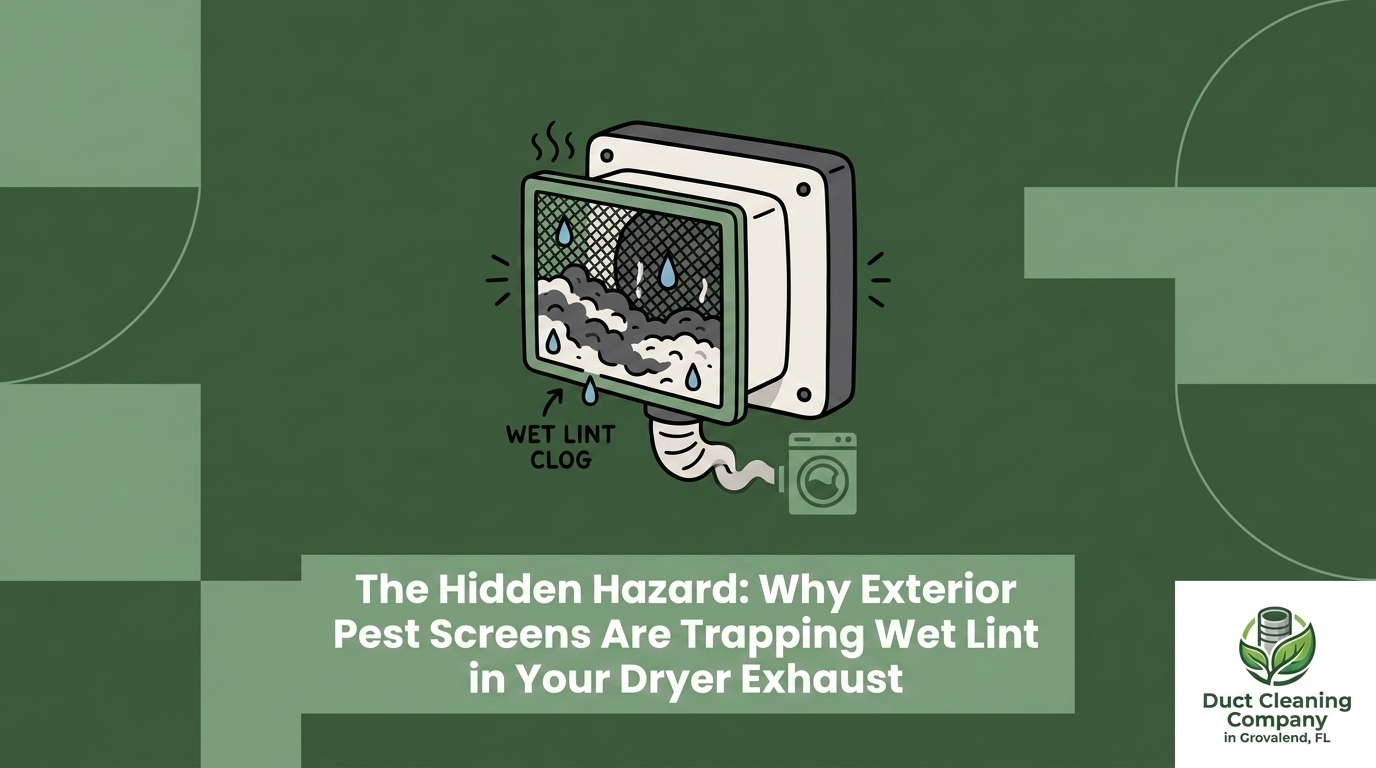
Why Exterior Pest Screens Are Trapping Wet Lint in Your Dryer Exhaust
Adding a bug screen to your vent seems smart, but it fundamentally breaks your exhaust system. This common modification traps moisture, doubles drying times, and creates a hidden fire hazard.
The Well-Meaning Mistake: Adding Bug Screens to Dryer Vents
If your laundry cycles are taking longer than ever and the utility room feels like a sauna, you might be wondering why exterior pest screens are trapping wet lint in your dryer exhaust instead of just keeping the bugs out. At Superior Vent Services, our technicians frequently encounter this common scenario—especially in homes built between 2010 and 2022. A homeowner or a well-meaning builder notices an exposed flap on the side of the house and decides to staple or screw a piece of fine wire mesh over the opening. The logic seems sound at first glance. After all, nobody wants wasps, mice, or birds nesting inside their ductwork. However, this single modification fundamentally breaks the mechanics of a residential exhaust system.
To understand why this happens, it is important to look at what your appliance is actually designed to do. A clothes dryer does not just heat up your garments; it actively removes heavy moisture by forcing large volumes of hot, damp air through the ductwork and out of the building. When you place a fine mesh screen over that exit point, you are placing a physical barrier directly in the path of that heavy, wet air. If you are currently dealing with doubled or tripled drying times due to airflow restriction, a blocked exterior screen is very likely the culprit.
Homeowners often assume that dryer lint is a dry, dusty substance that will simply blow right through small holes in a screen. In reality, the exhausted material is entirely different. Resolving this issue often requires professional dryer vent cleaning to remove the compacted material that has backed up into the walls.
• The DIY trap: Hardware stores sell generic pest guards that are often marketed for all exhaust vents, but they fail to mention that dryer exhausts are a strict exception.
• The builder oversight: Sometimes, new construction homes are finished with uniform screens over every exterior penetration, unknowingly setting the homeowner up for immediate appliance failure.
• The delayed symptom: A screen might allow air to pass for the first few weeks, giving a false sense of security before the microscopic particles begin to bridge the gaps in the wire.
Once you understand the technical reality of what is traveling through those ducts, it becomes clear why a simple bug screen is one of the worst things you can attach to your home.
The Physics of Dryer Exhaust: Heat, Moisture, and Lint
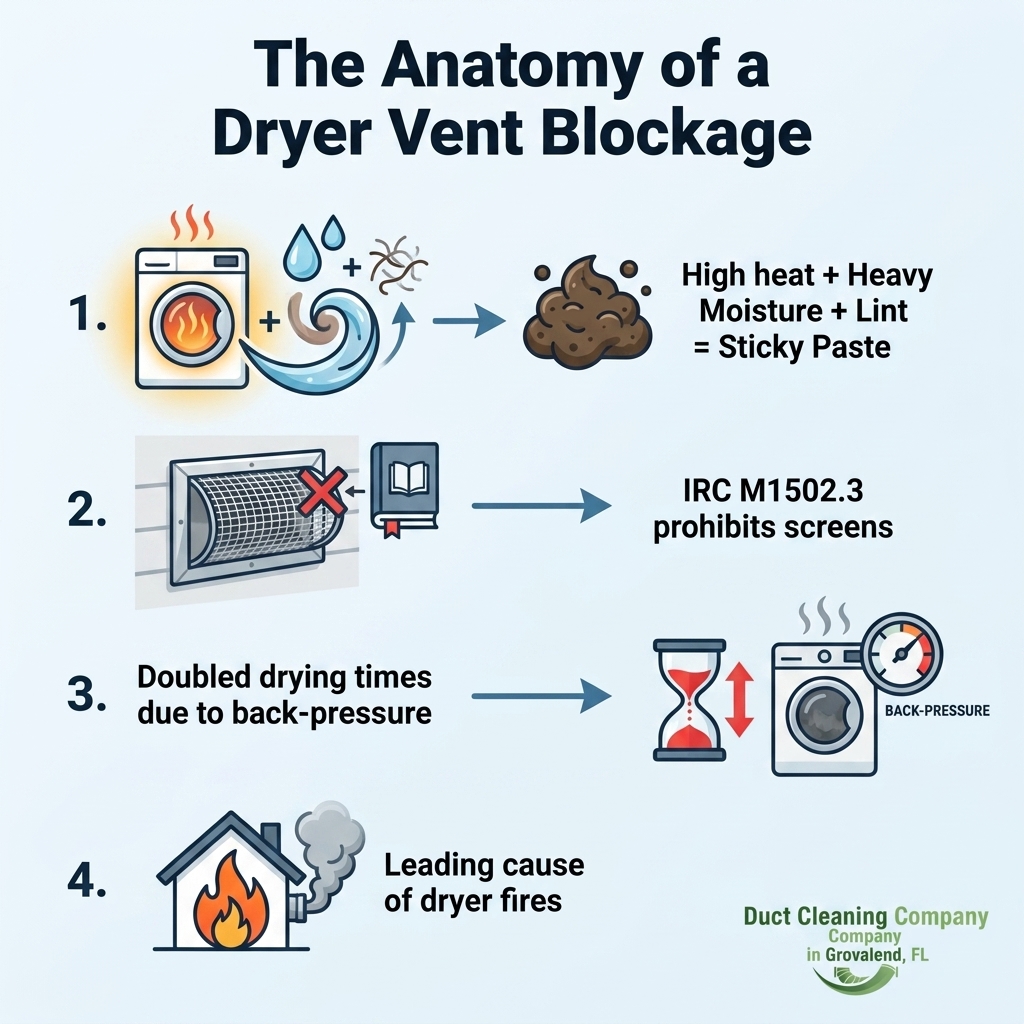
To truly grasp the hidden hazard, we have to look at the physics of what happens during a standard laundry cycle. When wet clothes tumble in a heated drum, the appliance must evaporate and expel up to 2 gallons of water per load into the surrounding air. This air is then pushed out by the blower motor, carrying thousands of microscopic fabric fibers with it. The resulting mixture is a combination of high heat, heavy moisture, and dense particulate matter.
When this hot, humid, lint-filled air travels through the duct and suddenly hits a cool, fine mesh screen on the exterior of the building, a rapid physical change occurs. The moisture instantly condenses on the cold metal wire. The microscopic lint particles then crash into that wet metal, sticking to it immediately. Because of Central Florida's high ambient humidity, this problem is severely amplified. The local climate prevents the moisture from evaporating naturally, making the exhausted lint significantly wetter and stickier. Instead of blowing away as dry dust, the lint forms a dense, glue-like paste that mats onto the exterior screen much faster than it would in a drier climate.
One recent late-April appointment perfectly illustrated this chain of events for our team. A local homeowner scheduled a comprehensive service with Superior Vent Services to have their air ducts, dryer vent, and chimney cleaned all at once. When our technicians arrived and inspected the exterior, they found a pest screen completely mortared shut with a thick, concrete-like layer of damp lint, which was forcing all the exhaust to back up into the laundry room.
• Dry Air & Dust (e.g., bathroom fan) — Behavior on Fine Mesh: Passes through mostly unimpeded — Impact on System Airflow: Minimal restriction over time
• Hot, Wet Lint (Dryer Exhaust) — Behavior on Fine Mesh: Condenses instantly into a sticky paste — Impact on System Airflow: Rapid blockage and severe back-pressure
How Back-Pressure Damages Your Appliance
When the exhaust air cannot escape through the blocked screen, it creates a phenomenon known as back-pressure. In the context of HVAC and exhaust systems, back-pressure is the resistance that the blower motor must fight against to push air out of the pipe. As the screen becomes an impenetrable wall, the air has nowhere to go. It slows down, cools off, and drops even more wet lint inside the ductwork hiding behind your walls.
This restriction forces the dryer to work significantly harder than its design allows. The internal temperature of the appliance spikes, sometimes exceeding 250 degrees Fahrenheit, because the heat cannot vent. Over time, this extreme thermal stress causes internal components to fail. Thermal fuses will blow to prevent a catastrophic meltdown, and heating elements will burn out prematurely because they are constantly surrounded by trapped, superheated air. What starts as a cheap wire mesh screen quickly evolves into an expensive appliance repair bill.
Building Codes and Fire Hazards: Why Screens Are Prohibited
The dangers of restricting exhaust airflow are so universally recognized that they are strictly regulated by national building standards. According to the International Residential Code (IRC) Section M1502.3, screens are explicitly prohibited at the termination of a standard 4-inch dryer exhaust duct. The code is written in black and white for a very specific reason: preventing the exact type of lint buildup that inevitably leads to dangerous blockages and property damage.
When a builder or a homeowner installs a bug screen, they are unknowingly creating a severe code violation. The rationale behind this regulation is rooted in life safety. According to the U.S. Fire Administration, the failure to clean dryer vents and clear structural blockages is the leading cause of home clothes dryer fires. When a screen traps lint at the end of the line, it forces the entire length of the ductwork to fill up with highly flammable material.
This risk is far from theoretical. In our experience servicing the local area, we recently helped a homeowner who was so fearful of a potential lint fire that they stopped using their appliance entirely. After our professional camera inspection revealed a severe clog caused by restricted airflow, the vent had to be cleared from the roof and the transition hose repaired before the system was safe to operate again. It is a stark reminder that airflow restrictions are not just inconveniences; they are active hazards.
The Hidden Fire Triangle in Your Laundry Room
To understand why a blocked vent is so dangerous, it helps to look at the fire triangle: heat, fuel, and oxygen. A clothes dryer inherently provides two of these elements. It draws in oxygen from the room, and it generates intense heat to dry the fabrics.
The lint that sheds from your clothes serves as the perfect fuel. In fact, dryer lint is so highly flammable that survivalists frequently pack it into their kits to start campfires. When a screen blocks the exit, the heat cannot escape, baking the trapped lint inside the duct until it reaches its ignition point. A single spark from a struggling heating element or a failing thermostat is all it takes to ignite the highly combustible material packed inside the walls of your home.
Identifying a Screen-Induced Blockage in Your System
If you suspect that your home might be suffering from restricted airflow, there are several physical symptoms you can look for before a complete failure occurs. Diagnosing a screen-induced blockage early can save you from costly appliance repairs and prevent a dangerous thermal event in your laundry room. Many homeowners mistakenly blame poor performance on the age of their appliance, rushing out to buy a new unit when the actual problem is attached to the outside of their house.
Our team recommends looking for these concrete signs that your system is dealing with a severe restriction:
1. Extended drying cycles: If you are experiencing doubled or tripled drying times—often extending past 90 minutes per load—due to airflow restriction, the moisture is not leaving the drum. Towels and heavy jeans taking three cycles to dry is the most common early warning sign.
2. Excessive external heat: Touch the top of your appliance while it is running. It should feel warm, but it should never feel hot to the touch. If the metal cabinet is burning hot, the exhaust heat is backing up.
3. Window condensation: If you notice moisture forming on the inside of your laundry room windows or a generally humid, swampy feeling in the room, the wet exhaust air is leaking back into your living space instead of pushing outside.
4. Burning odors: A faint, dusty burning smell when the unit runs indicates that lint is resting directly on the internal heating element because the blower cannot push it out.
5. Visible exterior matting: Walk outside and look at the vent termination. If you see a wire mesh covering the hole, or if the flap is propped open by a thick, grey paste, the system is fully compromised.
When these symptoms appear, the ductwork behind the walls is likely already packed with debris. Resolving the issue usually requires comprehensive air duct cleaning and exhaust clearing to remove the backlog of material that accumulated while the screen was in place.
Code-Compliant Alternatives to Keep Pests Out
The desire to keep rodents, birds, and insects out of your home is entirely valid, but it must be done safely. Fortunately, there are correct, code-compliant solutions for pest control that do not violate building codes or create fire hazards. At Superior Vent Services, the industry standard solution we install is a standard exterior louvered or magnetic damper dryer vent designed specifically for 4-inch exhaust systems.
A standard louvered vent cover utilizes a series of angled plastic or metal flaps. When the appliance is turned on, the force of the exhaust air pushes these flaps completely open. Because there is no mesh in the way, the hot, wet lint blows freely into the yard. The moment the cycle ends and the airflow stops, gravity snaps the louvers securely shut. This overlapping design creates a physical barrier that prevents birds from nesting and stops wasps from flying inside, all without restricting the outward airflow.
For areas with persistent rodent problems, a magnetic damper closure provides an even tighter seal. These specialized covers feature a single, solid door held shut by a carefully calibrated magnet. The blower motor provides just enough pressure to break the magnetic seal and push the door open. When the unit shuts off, the door snaps back into place, sealing tightly enough to keep out mice and rats without relying on dangerous wire mesh.
Why Damper Closures Outperform Mesh
The difference between a screen and a damper comes down to surface area restriction. A piece of wire mesh permanently blocks up to 50% of the opening's surface area before a single piece of lint even touches it. A damper, on the other hand, offers unimpeded airflow when open.
Our field-tested expertise at Superior Vent Services shows that our technicians frequently spot these hidden hazards that well-meaning builders and DIYers miss, allowing us to correct the issue before it causes appliance failure. Upgrading to a mechanical flap ensures that you maintain a secure perimeter against wildlife while allowing your appliance to breathe exactly as the manufacturer intended—maintaining 100% of the required airflow capacity. Keep in mind that replacing the cover is only the final step; correcting the exterior cover often requires assessing the entire duct run to address the signs you need dryer vent repair caused by the previous blockage.
Frequently Asked Questions About Dryer Vent Screens
Should a dryer vent have a bug screen?
No, a dryer vent should never have a bug screen or any type of wire mesh covering the exhaust opening. Screens quickly trap the hot, wet lint expelled during a laundry cycle, creating a solid paste that blocks airflow. This restriction forces the appliance to overheat, ruins internal components, and creates a severe fire hazard in your home.
How do I keep bugs out of my dryer vent without a screen?
The safest and most effective way to keep pests out is by installing a code-compliant louvered cover or a magnetic damper vent. These covers feature solid flaps that are pushed open by the exhaust air when the machine is running, allowing lint to escape freely. When the cycle finishes, the flaps snap shut securely, blocking insects, birds, and rodents from entering the duct.
Why is my dryer vent cover clogged with lint?
Your vent cover is likely clogged because it features a restrictive grid, mesh, or screen that catches the heavy, damp lint particles as they exit the building. Because dryer exhaust contains high levels of moisture, the lint condenses onto any physical barrier it hits, quickly turning into a thick, sticky paste that hardens and blocks the opening completely.
Is it illegal to put a screen on a dryer vent?
Yes, installing a screen on a dryer exhaust is a direct violation of standard building codes. The International Residential Code (IRC) Section M1502.3 explicitly prohibits the use of screens at the termination of a dryer duct. Building inspectors will flag this during a home sale or inspection because of the massive fire risk it poses to the property.
Why does my dryer take multiple cycles to dry after installing a pest guard?
The pest guard is restricting the volume of air your appliance can push out of the house. A clothes dryer relies on high-velocity airflow—often pushing 100 to 160 cubic feet of air per minute (CFM)—to carry moisture away from the wet tumbling fabrics. When a guard creates back-pressure, the humid air stays trapped inside the drum, forcing you to run the machine two or three times to achieve dry clothes.
What is the difference between a bug screen and a louvered vent cover?
A bug screen is a static piece of wire mesh that permanently obstructs the opening and catches debris. A louvered vent cover is a dynamic, mechanical barrier featuring flaps that open fully under pressure and close via gravity. Louvers allow wet lint to pass through completely unimpeded while still providing a secure barrier against outside pests when the appliance is off.
Ensure Your Dryer Exhaust is Safe and Code-Compliant
Trapping wet lint with an exterior screen is a well-intentioned mistake that carries severe consequences. What starts as a simple attempt to keep bugs out quickly evolves into restricted airflow, skyrocketing utility bills, ruined heating elements, and a very real risk of a house fire. Your appliance requires a clear, unobstructed path to safely vent extreme heat and heavy moisture.
You deserve the peace of mind that comes from knowing your home is protected by a scientifically grounded, code-compliant exhaust system. If your clothes are taking too long to dry, or if you suspect your exterior cover is violating building codes, it is time to seek a professional evaluation. Let the experts at Superior Vent Services help. Removing these hazards and scheduling professional dryer vent cleaning will restore your appliance's efficiency and keep your laundry room safe for years to come.
Other Blogs
Promotions
Take advantage of our latest promotions to save on chimney, dryer vent, and air duct cleaning—making it easier to protect your home and improve air quality at a great value.
10% off for veterans, law enforcement, and first responders


Customer Testimonials
Our customers love the noticeable difference in air quality, the professionalism of our team, and the peace of mind that comes with every thorough cleaning.


Copyright © 2025 Superior Vents. All rights reserved.
Designed & Developed by
