

Does Lowering the Thermostat Cool the House Faster? Debunking a Common Myth
Cranking your AC down to 60°F during a July heatwave won't cool your home any quicker. Understand how standard cooling mechanics actually work to save energy.
The Sweltering Return: Why We Reach for the Thermostat
Cranking the dial down to a freezing temperature does not lower the temperature in your home any quicker, which directly answers the common question: does lowering the thermostat cool the house faster? Debunking a common myth like this is essential for protecting your equipment. When you walk through the front door during a July peak summer heatwave, the wall of stagnant, hot air hits you instantly. Your home has been baking in the sun all day, and the indoor temperature is well above comfortable levels. In that moment of intense discomfort, human instinct takes over. You want immediate relief, so you walk straight to the wall control and drop the target temperature far below what you actually want the room to feel like.
Our team at Supreme Heating and Cooling sees the results of this aggressive approach almost every day during the peak of summer. It stems from a fundamental misunderstanding of how residential cooling systems operate. We are conditioned to believe that asking a machine for a more extreme result will force it to work harder and deliver faster relief. However, this tactic does not speed up the cooling process at all. Instead, it sets off a chain reaction of mechanical stress and unnecessary energy consumption. Understanding the actual mechanics of your system prevents severe internal damage, keeps your monthly utility bills in check, and ultimately improves your daily comfort. For comprehensive solutions and deeper insights into your home's climate control, exploring professional Air Conditioning services is the best first step.
The 'Gas Pedal' Misconception: Thermostats Are Switches, Not Throttles
The primary reason homeowners aggressively lower their temperature settings is due to the "gas pedal" analogy. When you are driving a car and want to accelerate faster, you press harder on the gas pedal to feed more fuel to the engine. It is a proportional response: more pressure equals more speed. Because we interact with so many devices that operate on a sliding scale of intensity—like dimmer switches for lighting or volume knobs on a stereo—it is completely logical that people assume their HVAC system works the exact same way.
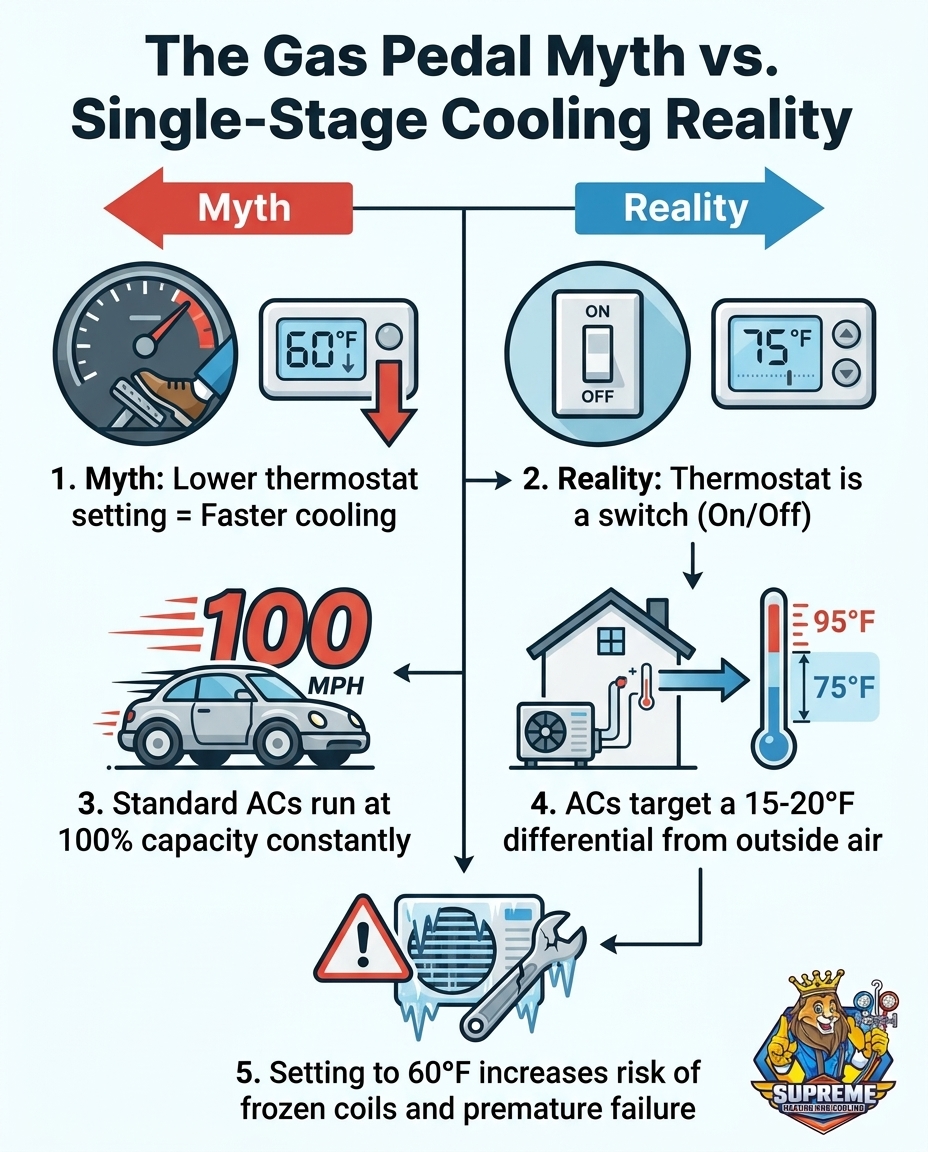
The reality of the switch: A standard thermostat is actually a binary switch, not a throttle. It does not control the speed, intensity, or volume of the cold air coming out of your vents. It only communicates two basic commands to your equipment: "turn on" or "turn off." The system only knows two states of existence. It is either running at its maximum designed capacity to meet the target temperature, or it is resting completely because the target has been met.
To better understand this, consider the fundamental differences between throttle mechanics and binary switch mechanics:
• Car Accelerator (Throttle) — Operational Mechanic: Variable input based on pressure — Resulting Output: Variable speed and power output
• Light Dimmer (Variable) — Operational Mechanic: Sliding scale of electrical current — Resulting Output: Gradual increase or decrease in brightness
• Standard Thermostat (Switch) — Operational Mechanic: Binary "On" or "Off" command — Resulting Output: Constant, fixed volume of cooling capacity
When you demand a drastic temperature drop, you are not pressing a gas pedal; you are simply moving the finish line further away. If your wall control is outdated or failing to read the room accurately, looking into thermostat upgrades and services can provide much better precision without forcing the equipment to overwork.
Inside Your System: The Mechanics of Single-Stage Cooling
To definitively debunk this myth, our technicians often ask homeowners to look at the machinery sitting outside. In our experience across Pennsylvania, the vast majority of residential homes utilize a standard single-stage air conditioner. The term "single-stage" means the compressor has exactly one speed of operation: 100 percent capacity. When the indoor temperature rises above your set preference, a relay clicks, and the outdoor compressor kicks on at full blast. It cannot run at 120 percent capacity because you set the dial lower, and it cannot run at 50 percent capacity when it gets close to the target.
Constant Speed Operation
Single-stage compressors do not have "low" or "high" gears. The system delivers a fixed amount of cooling power whenever it is turned on. The blower motor inside your furnace or air handler pushes a specific volume of air across the indoor coils, and the temperature of the air blowing out of your supply vents remains exactly the same regardless of what number is displayed on the wall. Whether you set it to 72 degrees or 60 degrees, the air coming out of the vent is identical in temperature and speed.
The 20-Degree Differential Rule: Another critical mechanical limitation is the temperature differential. Residential cooling equipment is engineered to maintain a 15 to 20-degree difference between the indoor air and the outdoor air. If it is 95 degrees outside, a perfectly functioning, well-maintained system can realistically lower the indoor temperature to about 75 degrees. Asking the system to overcome a 35-degree gap by setting it aggressively low simply ignores the physical limitations of the refrigerant cycle and the thermal envelope of your house.
What Really Happens When You Set the Thermostat to 60°F
If the air coming out of the vents doesn't get any colder, what actually happens when you punch in a 60°F thermostat setting? The physical consequence is simple but destructive: you force the system to run continuously for an extended period without its necessary resting cycles. Because the equipment will likely never achieve 60 degrees on a hot summer afternoon, the switch never turns off.
The Cascading Effects of Continuous Operation
Continuous operation without natural resting cycles severely stresses both the electrical and mechanical components of your HVAC system. Here is what happens inside the unit when it is denied a break:
• Motor overheating: The blower motor and the condenser fan motor generate heat as they run. Normal cycling allows this heat to dissipate. Running endlessly causes internal temperatures to spike, degrading the protective insulation on the motor windings.
• Capacitor strain: The electrical components that help start and run the motors are forced to sustain a constant electrical load, drastically shortening their lifespan.
• Energy waste: Because the system draws a massive amount of electricity every hour it runs, forcing it to chase an impossible target causes your electric meter to spin continuously, resulting in shockingly high utility bills without achieving faster comfort.
When the system runs without stopping, it is a clear sign of strain. Knowing when to worry about continuous AC cycling can help you intervene before a minor operational habit turns into a major mechanical failure.
The Regional Climate Factor: Humidity and Frozen Coils
Local weather conditions heavily dictate how your equipment behaves under stress. Having worked extensively in the Pittsburgh area, our team knows firsthand that our summer climate is characterized by high heat paired with heavy humidity. This specific humid continental climate requires your air conditioner to perform two distinct jobs simultaneously: it must lower the actual air temperature (sensible cooling) and it must extract heavy moisture from the air (latent cooling). The latent cooling load in our region is massive during July and August.
The science of condensation: As warm, humid indoor air blows across the freezing cold evaporator coil inside your ductwork, the moisture in the air condenses into water droplets on the metal fins. Under normal operation, this water drips safely down into a drain pan and flows out of the house. The system then cycles off, allowing the coil to warm up slightly before the next cycle begins.
The freezing threat: When you aggressively lower the setting and force the system to run continuously, the evaporator coil never gets a chance to warm up. Because of the high local humidity, condensation forms on the coil faster than it can drain away. Eventually, the temperature of the coil drops below freezing, and that condensation turns to frost. Within a few hours of continuous running, that frost builds into a solid block of ice, completely choking off airflow and bringing your cooling process to a dead stop.
Unnecessary Wear and Tear: Protecting Your Compressor
While energy waste and frozen coils are immediate concerns, the long-term threat of this myth is premature equipment failure. The compressor, located inside the outdoor cabinet, is the heart of the entire refrigeration cycle. It is responsible for pumping refrigerant through the lines under high pressure. It is also the single most expensive component to replace in the entire system.
Forcing the system to run indefinitely without cycling reduces the overall lifespan of the compressor. Mechanical parts are rated for a certain number of hours of operation. When you treat the thermostat like a gas pedal, you are burning through those operational hours at an accelerated rate. Severe stress during peak heat often leads to sudden, catastrophic breakdowns exactly when the system is needed most.
Our dispatch team recently took a call from a homeowner on a sweltering summer day whose AC had completely stopped working under this exact strain. One of our technicians arrived quickly, identified the overworked component, and had the system running again within 30 minutes. While fast, efficient repairs provide immediate relief from the heat, avoiding the breakdown altogether is the ultimate goal. At Supreme Heating and Cooling, we are committed to providing honest, educational advice aimed at helping homeowners avoid this exact type of unnecessary mechanical wear and tear. If your system has already suffered under the strain of continuous running, seeking professional AC repair in Pittsburgh is crucial for restoring proper function.
Smarter Alternatives for Rapid Summer Comfort
Instead of relying on a debunked myth that damages your equipment, there are highly effective, myth-free strategies to properly manage your indoor temperatures and achieve rapid comfort during the hottest months.
Your Summer Comfort Checklist:
• Utilize programmable or smart controls: The best way to avoid walking into a sweltering house is to prevent it from getting sweltering in the first place. Program your system to begin cooling the home gradually an hour or two before you arrive.
• Set a reasonable, consistent temperature: Aim for a steady target between 72°F and 78°F. A consistent moderate setting is far easier for the equipment to maintain than wild, extreme temperature swings.
• Create a wind-chill effect: Use ceiling fans and portable fans to improve air circulation in the rooms you are actively using. Moving air evaporates moisture from your skin, making you feel several degrees cooler while the AC catches up to the target temperature.
• Prioritize professional upkeep: A clean, well-maintained system naturally cools faster than a neglected one. Another local customer recently scheduled a tune-up with our crew to get their system ready for the heat. We provided comprehensive, professional, and quick service to ensure their unit could handle the peak summer load efficiently. Scheduling routine AC maintenance ensures your coils are clean and your refrigerant levels are precise.
Frequently Asked Questions About AC Cooling Speed
Does setting the AC lower make it cool faster?
No, lowering your thermostat does not cool your house faster. Standard air conditioners operate at a single speed, meaning they pump out the same volume of cold air regardless of whether the thermostat is set to 72 degrees or 60 degrees. Setting it lower simply forces the system to run longer until it reaches that lower temperature, which wastes energy without speeding up the process.
Does putting the AC on a lower temperature make it work harder?
It doesn't work "harder" in terms of intensity, but it certainly works longer. Because single-stage compressors only have one operational speed, they exert the exact same amount of effort whenever they are on. However, this continuous, non-stop operation stresses the mechanical components over time and drastically increases your utility bills.
How long does it typically take an AC to cool a hot house?
Depending on the starting temperature, the quality of your home's insulation, and the size of the cooling system, it generally takes a standard system about 3 hours to drop the indoor temperature by 10 degrees. This is why gradual, programmed cooling is far more effective than trying to rapidly cool a house that has been baking in the sun all day.
Why is my house not cooling down when the AC is on?
If the system is running constantly but the house isn't cooling down, it could be due to a frozen evaporator coil, a severely clogged air filter, or low refrigerant levels due to a leak. When airflow is restricted or the refrigerant charge is incorrect, the system loses its ability to transfer heat out of the home, regardless of how long it runs.
What is the best thermostat setting for summer?
The Department of Energy recommends setting your thermostat to 78°F when you are home and need cooling, and setting it slightly higher when you are away. This balances personal comfort with energy efficiency, keeping your utility bills manageable while preventing the unit from overworking during the hottest parts of the day.
Keep Your System Running Efficiently All Summer
Patience and proper thermostat usage are key to staying cool without breaking your equipment. Treating your wall control like a binary switch rather than a gas pedal will protect your compressor from premature failure, prevent your coils from turning into blocks of ice, and keep your utility bills predictable. If you find that your system is constantly struggling to reach a reasonable temperature, or if it runs continuously without providing adequate relief, it is time to consult with local professionals. Promptly addressing performance issues and exploring smart climate control options will ensure your home remains a comfortable refuge against the heavy summer heat.
Other Blogs
Promotions
Take advantage of our latest promotions to save on chimney, dryer vent, and air duct cleaning—making it easier to protect your home and improve air quality at a great value.
10% off for veterans, law enforcement, and first responders


Customer Testimonials
Our customers love the noticeable difference in air quality, the professionalism of our team, and the peace of mind that comes with every thorough cleaning.


Copyright © 2025 Superior Vents. All rights reserved.
Designed & Developed by
