

When to Stop Repairing an Older AC: A Financial Breakdown of Planned Replacements
Stop pouring money into an obsolete R-22 system. We break down the exact math to help you find the financial tipping point between reactive repairs and a new installation.
Is Your Aging Air Conditioner Becoming a Financial Liability?
Are you wondering when to stop repairing an older AC: a financial breakdown of planned replacements is the most objective way to find your exact answer. Are you tired of crossing your fingers every time you turn on your cooling system, hoping it survives another sweltering afternoon? If you are constantly bracing for the next mechanical failure, your cooling system is no longer just a household appliance—it has become a growing financial liability.
The concrete problem most homeowners face is balancing the escalating costs of maintaining obsolete equipment against the long-term value of upgrading to modern technology. It is incredibly common to fall into the trap of paying for one minor fix after another, only to realize that those cumulative costs could have funded a significant portion of a brand-new installation. The critical decision point is finding the exact financial tipping point where repairing a depreciating asset becomes a guaranteed loss. By removing the emotional stress and panic from the equation, you can evaluate your HVAC system purely by the numbers.
When assessing air conditioning services, especially for aging R-22 refrigerant systems, a strategic, analytical approach reveals the true cost of ownership. The goal is to transition away from reactive emergency fixes and toward a proactive strategy that protects your home comfort and your wallet.
The Hidden Costs of Maintaining Obsolete R-22 Systems
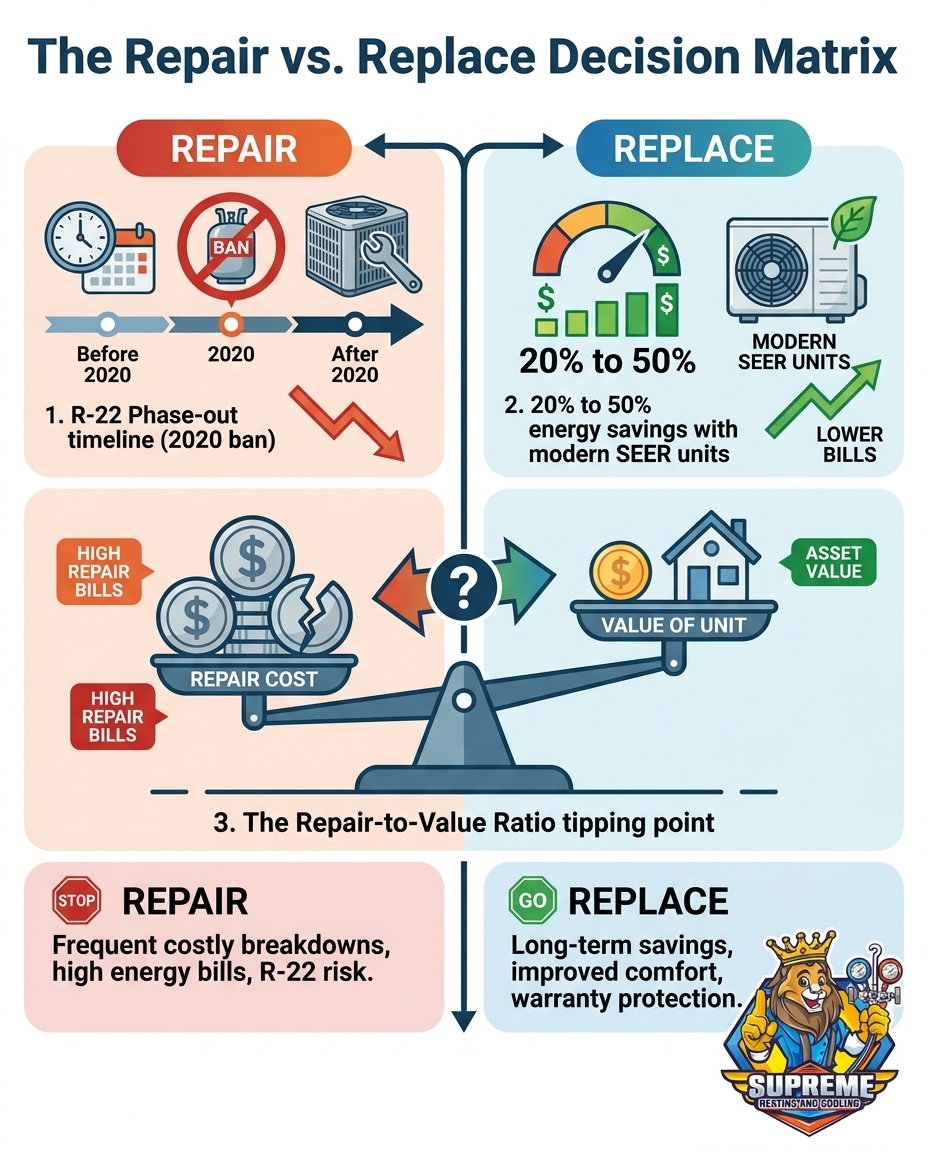
To truly understand the financial drain of an aging air conditioner, you have to look at the materials required to keep it running. On January 1, 2020, the production and importation of R-22 refrigerant became completely illegal in the United States. Because of this phase-out, the remaining supply of R-22 is incredibly scarce, driving the cost of a simple system recharge to astronomical levels.
Many homeowners mistakenly believe that an air conditioner naturally "uses up" refrigerant over time and requires routine top-offs. The reality is that an air conditioning system is a closed, sealed loop. If your system requires multiple refrigerant recharges in a single season, it is not consuming refrigerant—it is leaking it. A leak indicates a compromised evaporator coil or a failing line set. For obsolete R-22 refrigerant systems, a severe leak is generally a terminal issue, not a routine maintenance task.
Continuing to pour expensive, phased-out chemicals into a leaking system is a losing financial battle. Every time a technician adds refrigerant, you are simply treating a symptom while the underlying disease worsens. To illustrate the growing divide between old technology and modern standards, consider the operational differences:
• Refrigerant Availability — Obsolete R-22 Systems: Banned from production; highly scarce and costly. — Modern Sealed Systems: Uses modern, environmentally friendly, and widely available refrigerants.
• System Integrity — Obsolete R-22 Systems: Prone to micro-leaks in aging coils, requiring frequent service calls. — Modern Sealed Systems: Factory-sealed loops designed to hold pressure without routine top-offs.
• Repair Economics — Obsolete R-22 Systems: Parts are increasingly difficult to source, driving up labor and material costs. — Modern Sealed Systems: Parts are universally available, heavily supported by manufacturer warranties.
• Performance Under Load — Obsolete R-22 Systems: Struggles to maintain pressure, resulting in lukewarm air and high utility bills. — Modern Sealed Systems: Maintains consistent pressure for rapid, energy-efficient cooling.
When you evaluate the escalating frequency of these service calls, it becomes clear that investing in AC repair for a chronically leaking R-22 unit yields a negative return on investment.
How Peak Humidity Accelerates Compressor Failure
The climate you live in plays a massive role in how quickly your air conditioner degrades. During the intense summer cooling season in PA, the weather brings a punishing combination of high temperatures and heavy moisture. To keep your home comfortable, your air conditioner must perform two distinct jobs simultaneously: sensible cooling and latent cooling.
Sensible cooling is the process of dropping the actual temperature of the air inside your home. Latent cooling is the process of removing humidity from the air. In a hot, humid climate, latent cooling requires an immense amount of energy. When the air is thick with moisture, an aging, inefficient air conditioner is forced to run continuously just to wring the humidity out of the indoor environment, long before it can effectively lower the temperature on the thermostat.
This continuous runtime is exactly what kills older equipment. The compressor is the heart of your air conditioning system, responsible for pumping refrigerant through the coils. When high humidity forces an older unit to run continuously at maximum capacity, the compressor is subjected to relentless heat and friction. Over time, this compounding strain drastically increases the risk of catastrophic compressor failure—a breakdown that essentially totals the entire unit.
One local homeowner recently realized their old AC unit was no longer meeting their needs during the peak summer heat. After consulting with a professional who listened carefully to their concerns, they received an objective recommendation for the best replacement for their specific situation. The result was a meticulously clean, professional installation that immediately resolved their humidity issues. Addressing these climate-driven concerns proactively ensures your home remains comfortable during the most demanding weather, rather than waiting for the compressor to lock up on the hottest afternoon of the year.
Calculating Your Repair-to-Value Ratio
To remove the guesswork from your HVAC decisions, you should treat your air conditioner exactly like a depreciating financial asset. Just as you would not spend thousands of dollars replacing the transmission on a twenty-year-old car with a rusted frame, you should not authorize major repairs on a failing HVAC system without calculating the repair-to-value ratio. A math-driven decision matrix allows you to find your exact tipping point using percentages and ratios, rather than arbitrary flat dollar amounts.
Here is how to calculate whether your system is worth saving:
1. Determine the Replacement Value Baseline: Start by getting a clear estimate of what a brand-new, high-efficiency system would cost to install in your home. This gives you the denominator for your ratio.
2. Calculate the Repair Percentage: Divide the quoted cost of your current required repair by the total cost of a new system. If the repair cost exceeds a certain percentage (often 30% to 40%) of the new unit's value, the math heavily favors replacement.
3. Apply the Multiplier Rule: Conceptually adapt the well-known industry guideline by multiplying the chronological age of the system by the repair cost. If that resulting number represents a disproportionately high ratio compared to a new system's value, the existing unit is a financial liability.
4. Factor in Breakdown Frequency: A single repair might be a fluke, but multiple breakdowns over a two-year period indicate a cascading failure. Add the cost of your previous repairs to your current estimate to see your true repair-to-value ratio.
Evaluating System Age and Warranty Status
When executing this math-driven decision matrix, the chronological age of the equipment must be weighed against its operational wear-and-tear. An air conditioner that runs heavily during the summer cooling season in PA will experience far more mechanical degradation in ten years than a unit in a milder climate.
Furthermore, you must factor in the complete loss of manufacturer warranty protection. Most modern air conditioners come with a standard parts warranty that lasts between five and ten years. Once that warranty expires, you are entirely responsible for the cost of major components like the compressor, the evaporator coil, and the condenser fan motor. Paying out-of-pocket for these major parts on obsolete R-22 refrigerant systems is the definition of a poor financial investment, as you are pouring capital into an asset that has zero remaining protected lifespan.
Energy Efficiency and the ROI of Modern Upgrades
The financial breakdown of a planned replacement is not just about avoiding repair bills; it is heavily influenced by the long-term return on investment (ROI) generated through energy efficiency. Modern air conditioners are evaluated using a SEER (Seasonal Energy Efficiency Ratio) rating. Over the past decade, technological advancements have pushed minimum SEER ratings significantly higher, meaning that today's entry-level systems drastically outperform the premium equipment from ten or fifteen years ago.
According to data from the Department of Energy, upgrading to a high-efficiency unit can reduce your cooling energy usage by 20% to 50%. This is a staggering reduction in utility consumption. Older units waste electricity through worn-out motors, high-friction bearings, and inefficient single-stage compressors that pull maximum amperage every time they cycle on.
The compounding utility waste: Running a failing system is like driving a car with a severe fuel leak. You are paying for energy that is not translating into cooling comfort. By contrast, a modern variable-speed or two-stage compressor operates smoothly, dynamically adjusting its output to match the exact cooling load of the home.
When you calculate the month-over-month energy savings, those reduced utility bills begin to actively offset the initial investment of a planned replacement. If you are unsure when to replace your air conditioner, evaluating this compounding energy waste is often the deciding factor. Over a ten-year lifespan, a high-efficiency system can save a homeowner a substantial amount of capital purely through reduced electricity consumption.
Strategic Financing for a Planned Replacement
One of the most overlooked aspects of HVAC replacement is the strategic advantage of timing. There is a massive difference between the chaos of an emergency mid-summer breakdown and the calm, calculated execution of a planned, off-season or early spring installation.
During a recent summer heat wave, one homeowner experienced a complete system failure on a very hot day. While a rapid-response technician was able to arrive, identify the problem quickly, and have the unit running again in thirty minutes, relying on emergency rescues is incredibly stressful. When your system dies in the middle of July, you are forced to make rapid financial decisions under extreme duress, often prioritizing immediate availability over the best long-term equipment choice.
Exploring replacement options early allows you to make objective, numbers-based decisions without sweating through a 90-degree afternoon. A planned approach ensures the job is done efficiently, professionally, and without rushed timelines. It also gives you the breathing room to review transparent pricing and honest financial breakdowns without facing high-pressure sales tactics.
Furthermore, utilizing flexible HVAC financing options transforms a large capital expenditure into a manageable, predictable monthly operating cost. Financing acts as a strategic tool, making a high-efficiency upgrade immediately accessible without draining your emergency savings. When you combine low monthly payments with the 20% to 50% reduction in your utility bills, the net monthly cost of a new, reliable system is often far lower than homeowners anticipate. Upgrading obsolete R-22 refrigerant systems through strategic financing is a calculated financial maneuver that protects your household budget.
Make Your Next Move with Confidence
Replacing an obsolete air conditioning system is a calculated financial upgrade, not just an emergency expense. When you understand the math behind the repair-to-value ratio, recognize the terminal nature of R-22 leaks, and factor in the compounding utility waste of an aging unit during the summer cooling season in PA, the decision becomes remarkably clear. Understanding this data empowers you to avoid high-pressure situations and make a choice that protects your home's comfort and your financial future.
If you are tired of pouring money into a failing system, the best next step is to schedule a professional, objective evaluation. Getting a transparent assessment of your current equipment allows you to weigh your options accurately. Take control of your home comfort today and explore the benefits of a planned AC replacement in Pittsburgh to ensure your next move is made with complete confidence.
Frequently Asked Questions
When is it not worth fixing an AC?
It is generally not worth fixing an air conditioner when the cost of the repair, multiplied by the age of the unit, exceeds a significant percentage of the cost of a new installation. Additionally, if the unit requires phased-out R-22 refrigerant, has a compromised compressor, or is entirely out of manufacturer warranty, investing in repairs yields a negative return. A system that breaks down multiple times in a single season is also a prime candidate for immediate replacement.
What is the 5000 rule for air conditioners conceptually?
The 5000 rule is a conceptual math formula used to gauge whether a repair is financially viable. You multiply the chronological age of the air conditioner by the estimated cost of the current repair. If the resulting number exceeds a specific threshold (conceptually represented by the number 5000), the industry consensus is that the system is a depreciating liability and should be replaced rather than repaired.
Should I replace my 15-year-old AC?
Yes, replacing a 15-year-old air conditioner is almost always the most financially sound decision. At 15 years old, a cooling system has outlived its intended design life, its manufacturer warranty has fully expired, and it likely relies on obsolete refrigerant. Upgrading to a modern system will significantly reduce your monthly energy consumption and eliminate the looming threat of a catastrophic mid-summer breakdown.
How often should an AC unit be replaced?
A central air conditioning unit should typically be replaced every 12 to 15 years, depending on the climate and how rigorously it has been maintained. In regions with high humidity and intense summer heat, systems endure more wear and tear, often pushing them toward the earlier end of that lifespan. Regular preventative maintenance can help a system reach the 15-year mark, but efficiency will still naturally decline over that decade and a half.
How does high humidity affect an aging air conditioner?
High humidity forces an air conditioner to perform extensive latent cooling, meaning it must run continuously to wring moisture out of the indoor air before it can effectively lower the temperature. This relentless continuous runtime puts immense strain on aging motors and compressors. Over time, the inability to manage this heavy workload leads to accelerated mechanical wear and an increased risk of catastrophic system failure.
Why are R-22 refrigerant recharges no longer a viable long-term solution?
R-22 refrigerant recharges are no longer viable because the chemical was completely banned from production and importation in the United States in January 2020. This ban has made remaining supplies incredibly scarce and prohibitively expensive. Furthermore, needing a recharge means the system has a physical leak; continuing to fill a leaking system is a temporary, costly band-aid rather than a permanent mechanical solution.
Other Blogs
Promotions
Take advantage of our latest promotions to save on chimney, dryer vent, and air duct cleaning—making it easier to protect your home and improve air quality at a great value.
10% off for veterans, law enforcement, and first responders

Customer Testimonials
Our customers love the noticeable difference in air quality, the professionalism of our team, and the peace of mind that comes with every thorough cleaning.


Copyright © 2025 Superior Vents. All rights reserved.
Designed & Developed by
