

Why Is My AC Making a Loud Humming Noise But Not Cooling?
A loud buzz from an AC that refuses to cool means the system is drawing locked rotor amps. Find out which parts fail in late summer and why shutting off power immediately saves your compressor.
What to Do When Your AC Condenser Hums But Refuses to Cool
If you are standing in your yard wondering why your AC is making a loud humming noise but not cooling, you are facing a critical electrical event, not just a mechanical nuisance. Walking outside into the sweltering heat only to find your condenser unit buzzing aggressively while the fan blades sit completely still is enough to make any homeowner panic. That distinct, heavy hum is the sound of electrical current meeting immense resistance, and it requires immediate intervention to prevent catastrophic damage to your system.
When an air conditioning unit hums but refuses to start, the internal motors are stalled. The electrical grid is sending high-voltage power to the unit, but a failed component is preventing the mechanical parts from turning. Because the electricity has nowhere to go, it begins generating massive amounts of heat within the wiring and the compressor windings. Your immediate priority is to stop this cycle before it destroys the most expensive parts of your cooling system. If you need professional assistance, reaching out for comprehensive air conditioning services is the safest way to diagnose the underlying fault.
Why Immediate Action is Non-Negotiable
Many homeowners assume that a humming sound is just a sign that the unit is "trying" to work and might eventually kick on if left alone. This is a dangerous misconception. A stalled motor is not simply struggling; it is actively trapped in a locked state. Leaving the thermostat set to "cool" while the outdoor unit hums allows continuous high voltage to flow into a stationary motor.
• Step 1: Shut off the thermostat. Immediately switch your indoor thermostat from "cool" to "off" to stop the low-voltage signal from calling for cooling.
• Step 2: Flip the breaker. Locate your electrical panel and turn off the dedicated breaker for the outdoor AC condenser. This completely severs the high-voltage power supply.
• Step 3: Call a professional. High-voltage electrical diagnostics require specialized training and tools to perform safely.
Taking these three steps within the first few minutes of noticing the hum can mean the difference between a simple component replacement and a total system failure.
The Mechanics of the Hum: Understanding Locked Rotor Amps
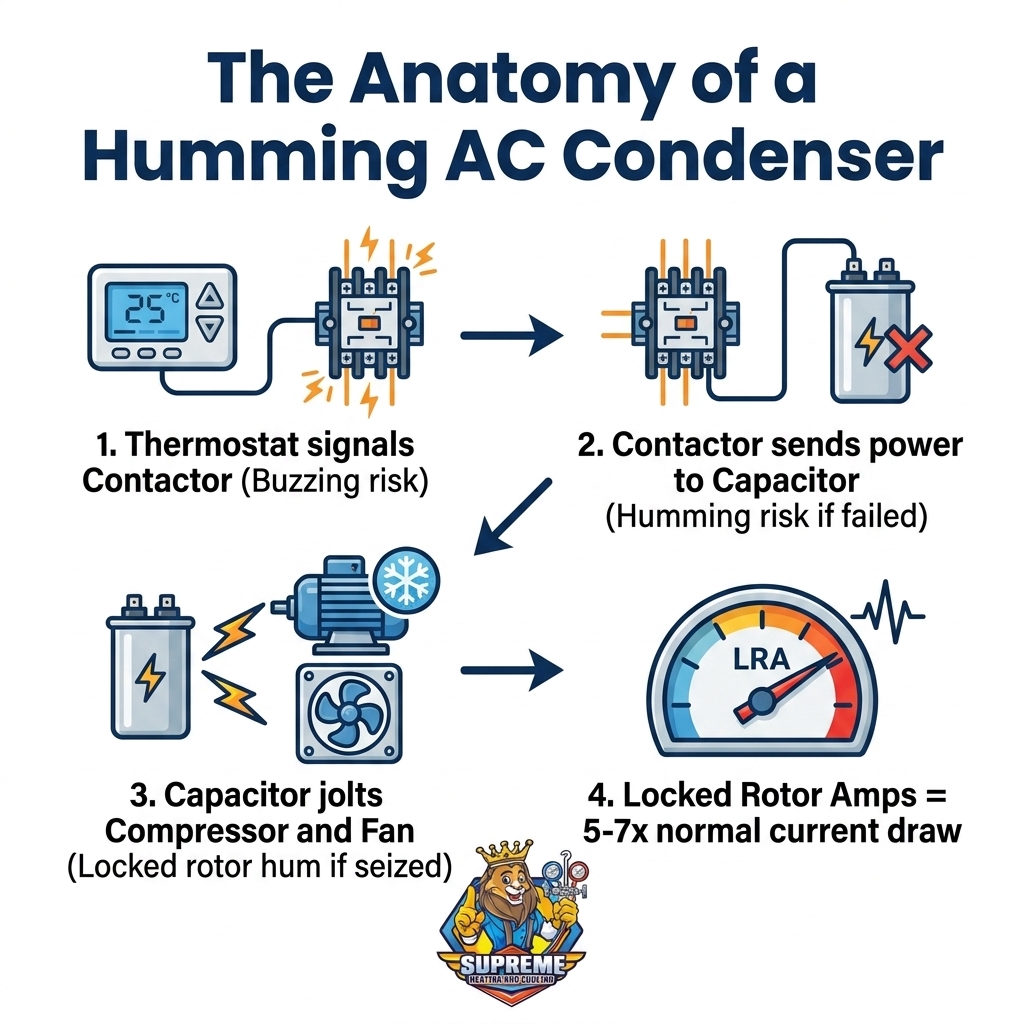
A humming AC condenser indicates an electrical stall where the motor attempts to start but cannot turn, resulting in locked rotor amps drawing excessive power. This massive surge of electricity rapidly overheats wiring and components. The top three culprits are a failed capacitor, a faulty contactor, or a seized compressor.
To understand why the hum is so dangerous, you have to understand the physics of an electric motor. When a motor first starts, it requires a massive influx of energy to overcome inertia and get the heavy internal components spinning. Once the motor is running, the electrical current drops down to a manageable, steady state. However, if the motor cannot spin, that initial massive influx of energy never drops down. This state is known in the HVAC industry as pulling "locked rotor amps" (LRA).
What Exactly Are Locked Rotor Amps?
Under normal conditions, your air conditioner might draw 10 to 15 amps of electricity to maintain a cooling cycle. During the fraction of a second it takes to start up, it might pull 60 to 70 amps. When a component fails and the motor stalls, it continuously pulls those 70 amps—often 5 to 7 times the normal running current.
Because the motor isn't spinning, it isn't moving air or refrigerant to cool itself down. The electrical energy converts directly into thermal energy. Wires begin to melt, insulation burns away, and internal components warp from the intense heat. This is exactly why leaving a humming unit turned on is an active hazard. The three primary components that cause this specific type of electrical stall include:
• The Dual Run Capacitor: The battery-like device that provides the initial electrical jolt to start the motors.
• The Contactor Relay: The high-voltage mechanical switch that allows power to flow from your electrical panel into the condenser.
• The Compressor: The heavy-duty pump that pressurizes the refrigerant, which can mechanically seize up and refuse to turn.
The Most Common Culprit: A Failed Dual Run Capacitor
By far, the most frequent reason an air conditioner hums without the fan turning is a blown dual run capacitor. The dual run capacitor acts as a massive energy reservoir. Your home's standard electrical grid does not provide enough instantaneous torque to get the heavy compressor and fan motors spinning simultaneously. The capacitor stores up energy and releases it in a powerful jolt to kickstart the system, then provides a continuous, steady electrical phase to keep things running smoothly.
Because these components handle massive amounts of electricity, they are highly susceptible to thermal stress. August late-summer cooling wear degrades the internal fluids and metallic shielding of the capacitor. After months of continuous operation through intense heat waves, the capacitor loses its ability to hold a charge. When the thermostat calls for cooling, the motors receive just enough power to hum, but lack the torque required to actually spin.
How Heat Degrades Electrical Components
Capacitors are filled with a dielectric fluid that helps manage the intense heat generated by storing high-voltage electricity. Over time, and especially during periods of prolonged high outdoor temperatures, this fluid begins to break down and expand. You can often visually identify a bad capacitor because the top will bulge outward like a swollen tin can. Once this happens, the component is completely dead and must be replaced.
During a particularly brutal summer heatwave, one local homeowner experienced this exact issue when their system stopped working entirely on a very hot day. A technician arrived quickly, identified a swollen and failed capacitor, and swapped the component. The entire system was back up and running within thirty minutes, highlighting how a dramatic-sounding failure is often tied to a single, easily replaceable part. Understanding how electrical loads impact your home can also help you recognize what causes fuse box short circuits, as overloaded HVAC components place heavy stress on your entire electrical panel.
Faulty Contactor Relays and High-Voltage Hazards
If the capacitor is healthy, the next most likely culprit for a loud electrical buzzing or humming sound is the AC contactor. The contactor is a heavy-duty mechanical switch located inside the outdoor unit. When your indoor thermostat decides the house needs to be cooled, it sends a low-voltage signal (usually 24 volts) out to the condenser. This low-voltage signal energizes a magnetic coil on the contactor, which violently pulls down a heavy metal plate, closing the circuit and allowing 240 volts of high-voltage electricity to rush into the compressor and fan.
Over time, the metal points where this high-voltage connection is made become pitted, scorched, and burned from thousands of electrical arcs. Insects, debris, and dirt can also get trapped between the contact points. When the magnetic coil tries to pull the switch closed, the uneven or blocked surface prevents a clean connection. The switch rapidly bounces up and down, creating a loud, aggressive chattering or buzzing sound as high-voltage electricity arcs across the gap.
The Danger of Pitted Contacts
A buzzing contactor is highly dangerous because it delivers erratic, unstable voltage to the compressor. Compressors require smooth, continuous power; erratic voltage will cause the compressor to overheat and eventually burn out entirely.
Never attempt to test, bypass, or manually push down a contactor switch yourself. This component directly handles lethal amounts of high-voltage electricity. Pushing on a faulty contactor with a screwdriver is a common DIY mistake that can result in severe electrical shock, arc flashes, or permanent damage to the HVAC system. Supreme Heating and Cooling provides fast, reliable emergency AC services to resolve electrical and mechanical failures safely, ensuring your system is diagnosed without putting your home or your safety at risk.
Mechanical Failure: The Locked Rotor Compressor
The most severe reason an air conditioner will hum without cooling is a locked rotor compressor. In this scenario, the electrical components—the capacitor and the contactor—are working perfectly. They are delivering the correct voltage and the necessary starting jolt. However, the internal mechanical parts of the compressor have physically seized together and refuse to move.
The compressor is the heart of the air conditioning system, responsible for pumping high-pressure refrigerant through the lines to remove heat from your home. Like a car engine, it contains tightly machined metal parts moving at high speeds, lubricated by specialized oil. If the system loses refrigerant, leaks oil, or simply suffers from decades of wear and tear, the metal parts will grind together and fuse solid.
Diagnosing a Terminal Compressor Failure
You can often distinguish a seized compressor from a bad capacitor by the specific sequence of sounds it makes. When the thermostat calls for cooling, you will hear a very deep, heavy hum from the outdoor unit. This hum will last for about three to five seconds, followed immediately by a sharp "click," after which the unit goes completely silent.
That click is the thermal overload switch. The compressor pulls so much locked rotor amperage trying to spin its seized internal parts that it instantly overheats. The thermal overload switch trips to cut the power and prevent the compressor from catching fire. Once the compressor cools down, the cycle will repeat.
When older units reach this point of terminal mechanical failure, a full replacement is often the most practical and cost-effective path forward. For example, a homeowner facing a severe cooling failure last spring opted for a complete installation after their aging unit seized; the technician provided knowledgeable guidance to select a modern system, resulting in a professionally installed unit that completely resolved the ongoing issues. If you are facing a seized compressor, exploring professional AC replacement options is usually the next required step.
Why You Must Never Repeatedly Reset a Humming AC
When faced with a hot house and a malfunctioning air conditioner, a common homeowner reaction is to go to the electrical panel, flip the breaker off, and immediately flip it back on, hoping the system will magically "catch" and start running. Some homeowners will do this five or six times in a row. This is the absolute worst action you can take for a stalled HVAC system.
Pittsburgh's late-summer humidity makes a broken AC an urgent comfort issue, but forcing a stalled system to run will only cause permanent, costly damage. Every single time you flip that breaker back on and force electricity into a stalled motor, you are sending a massive surge of heat and amperage through the copper windings of the compressor.
The "Restart" Myth
Electrical failures in HVAC systems do not resolve themselves through repetition. If a capacitor is dead, no amount of breaker-flipping will bring it back to life. Instead, you are subjecting the most expensive component in your system (the compressor) to extreme thermal abuse.
• Normal Start — Amperage Draw: High for 0.5 seconds — Heat Generation: Minimal — Risk to Equipment: Low (Normal Operation)
• Normal Running — Amperage Draw: Low and steady — Heat Generation: Dissipated by fan — Risk to Equipment: None
• Stalled Motor (Humming) — Amperage Draw: 5-7x normal current — Heat Generation: Extreme, rapid buildup — Risk to Equipment: High (Melted wires, burnt windings)
• Repeated Breaker Resets — Amperage Draw: Continuous high spikes — Heat Generation: Cumulative, unable to cool — Risk to Equipment: Severe (Terminal compressor failure)
While the heat inside your home is uncomfortable, forcing a broken system will quickly turn a minor electrical repair—like a simple capacitor swap—into a total system failure that requires a complete replacement. Once you hear the hum, turn the breaker off and leave it off until a licensed technician arrives.
Frequently Asked Questions About Humming AC Units
Why is my AC humming but the fan isn't turning?
This usually indicates a bad dual run capacitor or a seized condenser fan motor. The hum you hear is the electrical current reaching the motor, which is trying to start but lacking the torque to actually spin the blades. Because the capacitor provides the initial burst of energy required to move the heavy fan, a failure leaves the motor stalled and humming. Turn off the power immediately to prevent the motor from burning out.
Is it safe to leave a humming AC turned on?
Absolutely not; a humming AC is an active electrical hazard. Leaving the system turned on while it is stalled forces the unit to pull massive amounts of locked rotor amperage. This electrical resistance generates extreme heat that can melt wire insulation, destroy the compressor windings, and create a severe fire hazard. You must shut off the thermostat and the breaker immediately.
How do you fix an AC that hums but won't start?
Turn off the power immediately and call a licensed HVAC technician to safely test the high-voltage components. Because the root cause is almost always electrical—such as a failed capacitor or a pitted contactor relay—it requires specialized multimeters to diagnose safely. Attempting to fix high-voltage HVAC components without proper training puts you at risk of lethal shock.
What causes an AC contactor to buzz?
A buzzing contactor is caused by debris, pests, or pitted electrical contacts preventing the magnetic coil from pulling the switch closed cleanly. When the metal points cannot make a solid connection, high-voltage electricity arcs across the gap, creating a loud, aggressive buzzing or chattering sound. This component requires professional replacement, as it handles the main 240-volt power supply for the entire outdoor unit.
Can a tripped breaker cause my AC to hum?
No, if the breaker is tripped, there is absolutely no power flowing to the unit, so it will be completely silent. A tripped breaker cuts the electrical circuit entirely. If your air conditioner is humming, buzzing, or clicking, it means the unit is actively receiving high-voltage power but is mechanically stalled and unable to operate.
Stop the Hum and Restore Your Cooling Safely
Understanding why your AC is humming is the first step in protecting your home from further damage, but resolving the issue safely requires professional expertise. A humming condenser is a clear sign that your system is actively struggling against an electrical or mechanical roadblock. Leaving the power on, or attempting to repeatedly reset the system, will only escalate a manageable repair into a catastrophic failure.
By immediately shutting off the power at the breaker, you protect the heavy-duty components from burning out under the stress of locked rotor amps. Once the system is safely powered down, a licensed professional can properly test the voltage, swap out degraded components, and restore your comfort without risking your safety. If you are dealing with a stalled, buzzing system, reach out to a local expert for fast, safe AC repair in Pittsburgh to get your cooling back online.
Other Blogs
Promotions
Take advantage of our latest promotions to save on chimney, dryer vent, and air duct cleaning—making it easier to protect your home and improve air quality at a great value.
10% off for veterans, law enforcement, and first responders


Customer Testimonials
Our customers love the noticeable difference in air quality, the professionalism of our team, and the peace of mind that comes with every thorough cleaning.


Copyright © 2025 Superior Vents. All rights reserved.
Designed & Developed by
