

What Our Techs Look for When Your AC Trips the Breaker Repeatedly
A flipped breaker is an active safety mechanism protecting your home. Learn how technicians test compressor startup amperage to pinpoint the exact cause of the electrical failure.
When the AC Keeps Tripping the Breaker: Finding the True Cause
When the house suddenly goes quiet on a sweltering afternoon, understanding exactly what our techs look for when your AC trips the breaker repeatedly can save you from a catastrophic system failure. It is incredibly frustrating to lose your cooling during Pennsylvania summer peak usage, and the immediate instinct for most homeowners is to march down to the basement and forcefully flip the switch back on. However, that flipped switch is not a nuisance—it is a critical safety mechanism actively protecting your home from severe electrical hazards.
Before you touch that panel again, whether you need air conditioning services or comprehensive AC repair in Pittsburgh, it pays to understand exactly what is happening behind the scenes. Homeowners often face a confusing dilemma: wondering if they need to call an electrical contractor to replace a bad electrical panel, or if they need an HVAC technician to diagnose a failing air conditioning unit. The reality is that a tripping breaker is merely a symptom of a deeper conflict between your home's power supply and your cooling equipment.
Professional diagnostics require a systematic approach to isolate these two distinct systems. By methodically ruling out variables, technicians can determine whether the root cause is a simple, inexpensive weak breaker or a failing compressor that is drawing a dangerous amount of electrical current. Finding the true cause requires specialized tools, a deep understanding of electrical loads, and a strict adherence to safety protocols.
The Critical Danger of Repeatedly Resetting Your Breaker
The underlying problem: A standard central air conditioning circuit breaker is typically sized between 20 and 50 amps, depending on the precise specifications of your condenser unit. This breaker functions as a protective gateway, monitoring the flow of electricity from your main panel to your outdoor equipment. When the electrical draw exceeds the breaker's maximum safety rating, the internal mechanisms separate, instantly cutting the power to prevent the wires from overheating and melting.
The unseen cause of damage: Every time a homeowner forcefully resets a tripped breaker under an active fault condition, severe mechanical degradation occurs inside the breaker itself. The internal contacts can experience microscopic arc flashes—tiny electrical explosions—that pit and scar the metal. Over time, this repeated stress weakens the breaker, making it more prone to tripping at lower and lower electrical loads. Worse, if the breaker eventually fails to trip when it should, the resulting surge of uncontrolled electricity can lead to permanent compressor burnout or even a catastrophic electrical fire within the walls of your home.
The professional solution: A breaker that trips more than once is no longer a fluke; it is an active warning sign that requires immediate intervention. Ignoring the trip and forcing the system to run will only multiply the cost of the eventual repair. When a system refuses to stay powered on, the safest course of action is to leave the breaker in the "off" position and contact a professional for emergency AC services to safely evaluate the electrical load.
Isolating the Electrical Panel from the HVAC Equipment
The first step in any professional diagnostic methodology is to definitively rule out the home's electrical infrastructure before tearing into the air conditioner itself. Technicians must verify that the power supply is stable and that the safety mechanisms are functioning exactly as designed. This isolation phase prevents the costly mistake of replacing expensive HVAC components when the true culprit is a fifty-dollar piece of plastic in the basement.
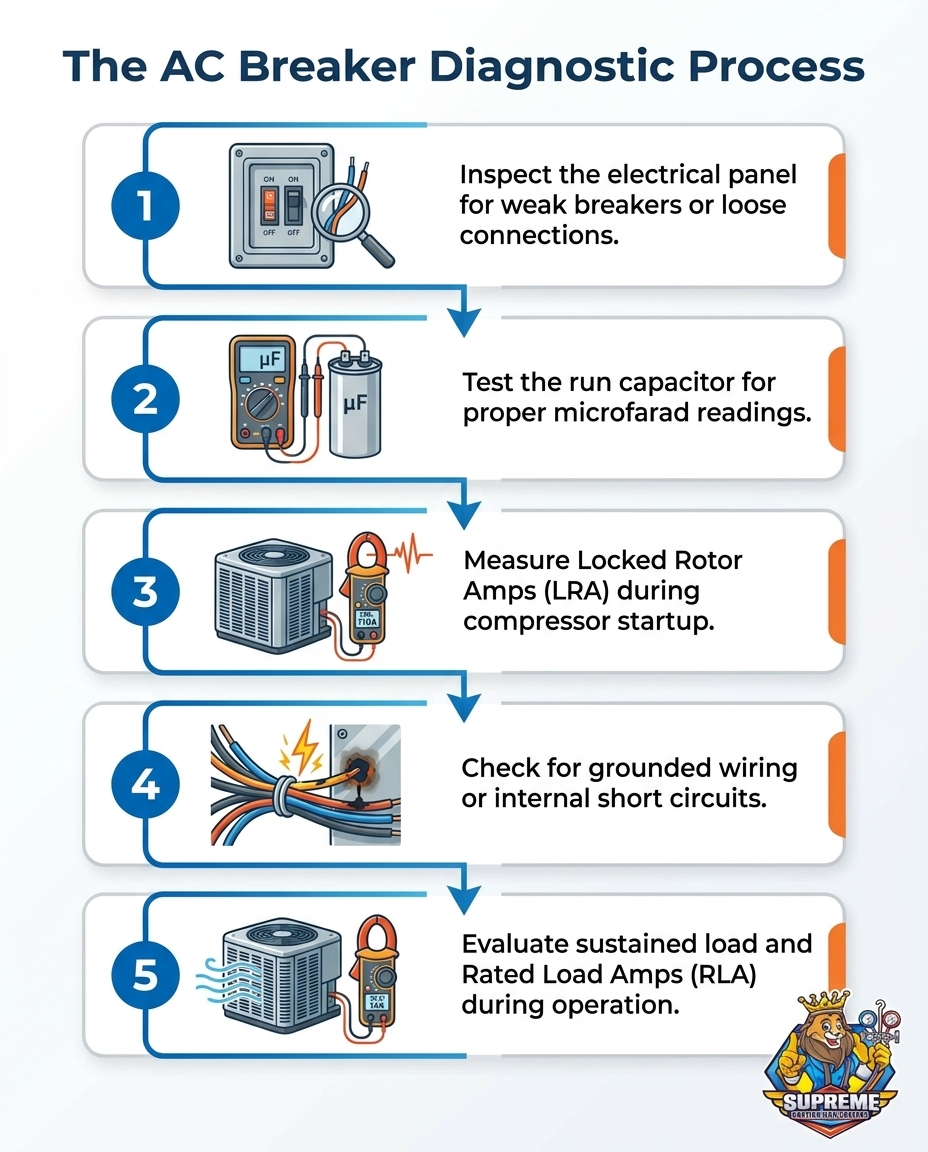
To safely isolate the systems, professionals follow a rigorous testing sequence:
1. Visual and Thermal Inspection: Technicians examine the breaker for obvious signs of physical wear, melting, or discoloration. They also check the bus bar—the metal spine inside the panel where the breaker connects—for heat damage or pitting, which indicates a poor connection.
2. Verifying Wire Integrity: The connections where the high-voltage wires enter the breaker must be torqued to precise specifications. Loose connections create high electrical resistance, which generates immense heat and causes the breaker's internal bimetallic strip to warp and trip prematurely.
3. Testing the Voltage Drop: Using specialized multimeters, technicians measure the voltage drop across the breaker while the system is attempting to run. This confirms whether the breaker is passing clean, uninterrupted power to the condenser unit outside.
4. Identifying False Positives: An aging or weak breaker can lose its structural tension over decades of use. When this happens, a 40-amp breaker might trip when the air conditioner is only pulling a perfectly normal 18 amps. This creates a "false positive" for an HVAC failure, which is why ruling out the panel through electrical diagnostic services is an essential first step.
Measuring Compressor Startup Amperage (LRA vs. RLA)
Once the electrical panel has been cleared of any faults, the diagnostic focus shifts outdoors to the condenser unit. The most critical measurement a technician takes involves the electrical current required to operate the compressor, which is the heavy-duty pump that circulates refrigerant through your home.
Understanding this process requires defining two crucial electrical terms:
• Rated Load Amps (RLA): This is the normal, continuous electrical draw of the air conditioner while it is actively running and cooling your home. If a system's RLA is rated at 15 amps, it should hum along comfortably below that threshold for hours.
• Locked Rotor Amps (LRA): This is the massive, momentary surge of power required to overcome inertia and start the compressor from a dead stop. This surge only lasts for a fraction of a second, but it can be up to five times higher than the RLA.
Technicians use specialized amp clamps secured around the main power wires to capture the exact startup surge in real time. If the compressor is mechanically failing, the internal bearings may be grinding, or the motor may be seizing up. When a compressor physically seizes, the electrical draw spikes dangerously. In one instance involving an urgent health situation during a summer heatwave, an aging AC unit from the 1980s stopped working completely and continuously tripped the breaker upon startup. Because the compressor was locked and pulling excessive locked rotor amps, the system was beyond repair; it was promptly assessed and a new unit was installed the same afternoon to restore safe cooling.
The Role of the Run Capacitor
Before condemning an over-amping compressor, technicians always test the run capacitor. This small, cylindrical component acts like a battery, storing electricity to give the compressor an extra jolt of power during startup. If the capacitor is failing or completely dead, the compressor is forced to pull all of its starting amperage directly from the electrical panel, which almost always exceeds the breaker's threshold and causes an immediate trip. Testing the capacitor's microfarads with a multimeter is a standard, non-negotiable part of resolving over-amping issues.
Evaluating Sustained Electrical Loads During Peak Heat
There is a distinct diagnostic difference between a breaker that trips the millisecond the thermostat clicks on, and a breaker that trips after the air conditioner has been running smoothly for 30 or 40 minutes. Delayed trips are heavily influenced by environmental factors and sustained electrical loads.
During the height of summer, Pittsburgh's high summer humidity forces air conditioners to run much longer cooling cycles to properly dehumidify the indoor air. This extended operation time naturally increases the sustained electrical load on aging electrical components. Furthermore, extreme outdoor temperatures reduce the condenser unit's ability to dissipate heat into the surrounding air. When heat cannot escape, the internal components run significantly hotter, which directly increases the electrical resistance and forces the system to pull more amperage.
• Immediate Trip (0-5 seconds) — Typical Diagnostic Meaning: Massive electrical short or complete mechanical seizure. — Common Culprits: Dead capacitor, locked compressor, grounded wire, shorted contactor.
• Delayed Trip (15-45 minutes) — Typical Diagnostic Meaning: System is overheating or over-amping under sustained load. — Common Culprits: Dirty condenser coils, clogged air filter, failing fan motor, weak breaker.
Dirty condenser coils or severely clogged indoor air filters exacerbate this thermal buildup, slowly increasing the sustained electrical load inch by inch until it finally crosses the breaker's safety threshold. Not every delayed trip means the compressor is ruined, however. On one very hot day, an AC system stopped working mid-cycle and tripped the breaker. A technician was able to identify a specific airflow restriction causing the system to overheat, repaired the underlying issue, and had the AC back up and running within 30 minutes.
Tracing Short Circuits and Ground Faults
If the electrical panel is sound, the capacitor is healthy, and the compressor is not mechanically seized, technicians must hunt for electrical shorts within the equipment's wiring harness. Air conditioners are powerful machines that vibrate heavily during operation. Over years of use, these internal vibrations can slowly rub the protective rubber insulation off the wires inside the condenser unit.
The grounded compressor: One of the most severe electrical failures is a "grounded compressor." This occurs when the internal electrical windings inside the compressor motor break down and physically touch the copper casing of the unit. Electricity instantly flows directly to the ground rather than completing its intended circuit. Technicians test for this by using a multimeter to check for continuity between the compressor terminals and the copper refrigerant lines. If continuity exists, the compressor is grounded and must be replaced.
Low-voltage and high-voltage shorts: Short circuits can also occur in the high-voltage contactor (the heavy-duty switch that turns the outdoor unit on) or even within the low-voltage thermostat wiring. If a mouse chews through a control wire, or if a contactor physically welds itself shut due to electrical arcing, it will cause an instantaneous breaker trip the moment power is applied. Understanding what causes fuse box short circuits is essential for tracking down these hidden wiring faults before they cause permanent damage to the circuit board.
Why Dual-Trained Diagnostics Prevent Costly Guesswork
The complexity of a tripping breaker lies in the fact that it bridges two highly specialized trades: high-voltage residential electrical systems and complex HVAC mechanics. This intersection creates a common, expensive trap for homeowners. You might pay an electrician a dispatch fee only to be told that the panel is perfectly fine and the issue is with the air conditioner. Then, you have to pay an HVAC technician another dispatch fee to actually diagnose the compressor.
This is where Supreme Heating and Cooling's cross-trained expertise in both HVAC and electrical systems provides a distinct advantage. Working with dual-trained technicians means the entire circuit—from the bus bar in the basement to the run capacitor in the backyard—can be definitively tested in a single visit. There is no finger-pointing between contractors and no guesswork.
A cross-trained technician understands how a microscopic drop in voltage at the panel affects the internal temperature of the compressor motor. They can accurately determine whether an over-amping compressor caused the breaker to weaken, or if a weak breaker caused the compressor to starve for voltage. This holistic diagnostic approach accurately identifies the root cause immediately, saving homeowners significant time, frustration, and misdiagnosis costs.
Get a Definitive Diagnosis for Your Tripping AC Breaker
A tripping circuit breaker is never the actual problem; it is merely a symptom of an underlying electrical or mechanical failure. Accurate, methodical testing is the only way to find the cure. Guessing at the cause or replacing parts blindly is a dangerous game when dealing with 240 volts of electricity and expensive cooling equipment.
Specialized tools like multimeters, amp clamps, and microfarad testers are absolutely required to measure electrical loads safely and accurately. If your system refuses to stay powered on, do not force it. Continuing to reset a tripping breaker puts your home and your equipment at severe risk. Stop guessing, leave the power off, and schedule a professional evaluation to get your cooling restored safely and permanently.
Frequently Asked Questions
Is it safe to keep resetting my AC breaker?
No, it is highly dangerous to repeatedly reset a tripped breaker. Every time you force the breaker back on under a fault condition, you risk severe electrical arcing that degrades the internal contacts. This can ultimately lead to permanent compressor burnout, melted wiring, or an electrical fire inside your panel.
How do techs test if an AC compressor is failing?
Technicians use an amp clamp to measure the Locked Rotor Amps (LRA) during the exact moment the compressor attempts to start. If the compressor pulls significantly more amperage than its rated threshold, it indicates that the internal mechanical components are failing or seizing. They will also test the run capacitor to ensure it is delivering the proper voltage to assist the motor.
Why does my AC trip the breaker after running for a few minutes?
A delayed trip usually indicates an overheating issue rather than a direct short circuit. When condenser coils are dirty, air filters are clogged, or outdoor temperatures are extreme, the system cannot dissipate heat properly. This causes the internal components to run hotter, gradually increasing the sustained electrical load until it crosses the breaker's safety limit.
Can a bad capacitor cause the breaker to trip?
Yes, a failing or dead run capacitor is one of the most common causes of a tripped AC breaker. The capacitor acts like a battery that provides a massive jolt of energy to help the compressor start. Without that assistance, the compressor pulls all of its starting power directly from the breaker, causing an immediate overload and trip.
What is the difference between a weak breaker and an over-amping compressor?
A weak breaker has lost its internal structural tension and will trip at a much lower electrical load than it was designed to handle, creating a false positive for an HVAC failure. An over-amping compressor is mechanically failing and is genuinely pulling too much electricity. Technicians distinguish between the two by using a multimeter to measure the exact amperage draw while the system is running.
Other Blogs
Promotions
Take advantage of our latest promotions to save on chimney, dryer vent, and air duct cleaning—making it easier to protect your home and improve air quality at a great value.
10% off for veterans, law enforcement, and first responders

Customer Testimonials
Our customers love the noticeable difference in air quality, the professionalism of our team, and the peace of mind that comes with every thorough cleaning.


Copyright © 2025 Superior Vents. All rights reserved.
Designed & Developed by
