

The Mid-August AC Slump: Recognizing End-of-Season Wear Before a Breakdown
After months of heavy summer heat, your air conditioner is likely showing signs of mechanical fatigue. Spot the early symptoms of a failing capacitor before it causes a complete system breakdown.
Surviving the Late-Summer Heat: Why Your AC Feels the Strain
Here at Supreme Heating and Cooling, we see it every year: as summer in Pennsylvania enters its final, heavy stretch, avoiding the mid-August AC slump: recognizing end-of-season wear before a breakdown is the most important step you can take to protect your home's comfort. Since the first warm days of May, your cooling system has been running marathon after marathon to keep your living space comfortable. By the time mid-August arrives, all that relentless, daily work naturally starts to take a heavy toll on the machinery. You might begin to notice subtle changes in how your system sounds, how long it runs, or how the air feels coming out of the vents. When these symptoms appear, you face a critical choice: ignore these small quirks and hope the system makes it to fall, or schedule a professional diagnostic check with our team to catch mechanical fatigue early.
If your system is showing signs of distress, exploring professional air conditioning services or booking prompt AC repair in Pittsburgh can save you from a major headache.
Air conditioners are built to handle heat, but they are not immune to the laws of physics and friction. Every time your thermostat calls for cooling, a complex sequence of electrical and mechanical events takes place. Motors spin, compressors pressurize refrigerant, and fans move massive volumes of air. Over weeks and months of continuous operation, the components that drive this process experience microscopic wear. This phenomenon is known as mechanical fatigue. It does not mean your system is necessarily old or broken; it simply means the parts are tired from a heavy workload.
One of the most common victims of this late-summer fatigue our technicians encounter is the electrical capacitor. These small but mighty components bear the brunt of the startup stress every single time your air conditioner cycles on. When a capacitor begins to wear down, the entire system has to work harder to compensate. Recognizing the early warning signs of this specific type of fatigue is the key to preventing a minor wear-and-tear issue from cascading into a complete system failure right when you need cooling the most.
The Toll of Prolonged Heat and Humidity on Your Cooling System
In our years servicing HVAC systems throughout the Pittsburgh area, we've learned firsthand that late summer brings a distinct kind of prolonged heat and heavy humidity that prevents air conditioning systems from ever truly resting. When the outdoor air is thick with moisture, your cooling system has to perform two massive jobs simultaneously. First, it must lower the sensible temperature of the air. Second, it must remove the latent heat—the heavy moisture—from your indoor environment. This dual workload forces the system to draw more electrical amperage over much longer periods.
During a typical early summer day, your air conditioner might run for fifteen minutes, shut off, and rest for another twenty minutes. This resting period allows the compressor and blower motors to cool down before the next cycle. However, during the thick humidity of mid-August, those resting periods shrink or disappear entirely. The inability for the system to rest compounds mechanical fatigue over several months. Heat is the natural enemy of electrical components, and when parts are running constantly, they never get a chance to shed that excess thermal energy.
This environmental stress directly impacts the electrical components nestled inside your outdoor condensing unit. The wiring, the contactors, and especially the capacitors are subjected to sustained high temperatures from both the ambient outdoor air and the heat generated by the equipment itself. Over time, this bakes the components, degrading their ability to hold and transfer electrical charges efficiently. If you are wondering when to worry about continuous AC cycling, this constant electrical load and the resulting heat buildup is a primary reason we recommend having the system evaluated.
Furthermore, the longer the system runs to combat the humidity, the more air it pulls through your filter and coils. This means dust and debris accumulate faster in late summer than they do in June. A dirty system restricts airflow, which forces the blower motor to pull even more amperage to push the same amount of air. It becomes a vicious cycle: heat causes longer run times, longer run times cause dirt buildup, and dirt buildup causes even longer run times and higher electrical stress.
Listening for Trouble: Identifying Capacitor Fatigue
To understand why late-summer breakdowns happen, you first need to understand what an air conditioning capacitor actually does. Think of a capacitor as a powerful, high-voltage battery that stores energy. When your thermostat signals the AC to turn on, the power from your home's electrical panel isn't quite enough to get the heavy compressor and fan motors spinning from a dead stop. The capacitor delivers a massive, instantaneous jolt of stored electricity to jumpstart these motors. Once the motors are running, the capacitor continues to supply a steady, regulated current to keep them spinning efficiently.
Because the capacitor handles such high voltages and takes the brunt of the startup stress, our field team consistently finds it is the first component to suffer from mechanical fatigue. Identifying a failing capacitor requires paying close attention to how your system behaves, particularly the sounds it makes. Here are the key signs to watch for:
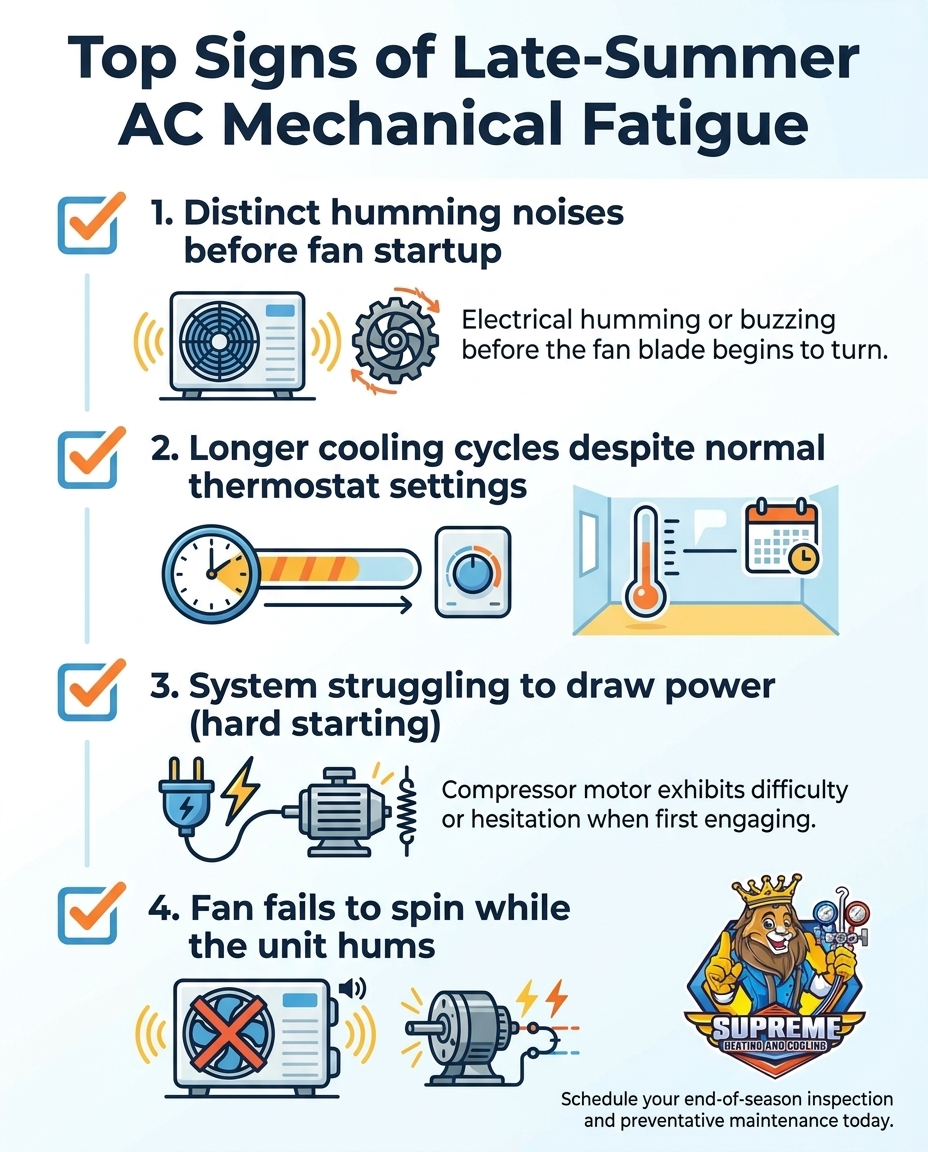
• Distinct humming noises before fan startup: If you hear a noticeable, vibrating hum coming from the outdoor unit just before the fan blades begin to spin, the capacitor is likely struggling to deliver that initial jolt of power.
• Delayed fan engagement: You might hear the system click on, but the fan hesitates for several seconds before slowly ramping up to speed. This sluggishness is a classic sign of a weakened electrical charge.
• Humming with a stationary fan: This is a critical warning sign. If the outdoor unit is humming loudly but the fan blades are not moving at all, the capacitor has likely failed completely, and the motor is locked in place trying to pull power it cannot get.
• Random system shut-offs: A failing capacitor can cause the electrical current to fluctuate, prompting the system's safety sensors to shut the unit down prematurely to protect the motors.
It is vital to state that you should never attempt to open the outdoor unit, touch the electrical panel, or test a capacitor yourself. Capacitors store lethal amounts of voltage, even when the power to the unit is turned off at the breaker. Testing and replacing these components must be handled exclusively by a licensed professional using specialized, insulated tools.
The Danger of Hard Starting
When a capacitor loses its ability to store a full charge, the system experiences a phenomenon known as "hard starting." Hard starting means the compressor and fan motors are struggling to draw enough power to turn on. Instead of a smooth, immediate startup, the motors pull excessive amperage directly from your home's electrical grid, causing the lights in your house to dim momentarily.
This massive electrical draw puts incredible stress on the compressor. The compressor is the heart of your air conditioning system and the most expensive component to replace. When forced to hard start repeatedly, the internal windings of the compressor overheat. Eventually, this excessive heat will trigger the thermal overload protection switch, shutting the system down entirely to prevent a catastrophic fire or total motor burnout. Catching a hard-starting issue early is the difference between a simple, routine fix our team can manage quickly and replacing the entire outdoor unit.
Monitoring Blower Motor and Compressor Stress
A failing capacitor rarely exists in isolation; it is usually the first domino to fall in a chain reaction of mechanical stress. Because the capacitor's job is to support the blower motor and the compressor, a weakness in the electrical charge forces these heavy-duty components to work much harder than they were designed to. When the motors are starved of the proper voltage, they draw more amperage to compensate. More amperage creates more heat, and heat degrades the internal insulation of the motors.
A pattern we see often during late-summer service calls is homeowners noticing longer cooling cycles. If your thermostat is set to the same temperature it was in June, but the system is taking twice as long to satisfy that setting, you are likely witnessing mechanical fatigue in real time. The compressor is running, but it isn't pumping refrigerant as efficiently. The blower motor is spinning, but it isn't moving air with the same force.
• Run Time Length — Normal Late-Summer Operation: Runs slightly longer during peak afternoon heat, but shuts off. — Sign of Mechanical Fatigue: Longer cooling cycles that never seem to end, even after the sun goes down.
• Startup Sound — Normal Late-Summer Operation: A solid click followed immediately by the fan spinning. — Sign of Mechanical Fatigue: Distinct humming noises before fan startup, or a loud buzzing sound.
• Airflow Temperature — Normal Late-Summer Operation: Consistently crisp and cold air from all vents. — Sign of Mechanical Fatigue: Air feels lukewarm or weakly pushed through the ductwork.
• Electrical Draw — Normal Late-Summer Operation: System cycles on without impacting the home's power. — Sign of Mechanical Fatigue: Lights dim noticeably every time the air conditioner turns on.
The greatest risk during this phase is the compressor overheating. When forced to operate with compromised supporting components, the compressor runs hotter and longer. Treating these symptoms as "normal" heat struggles is a common trap we see homeowners fall into. It is easy to assume the system is just having a hard time because it is hot outside. However, ignoring these longer cycles and subtle noises often leads directly to premature system failure. The equipment is telling you it is struggling, and intervening now can save the heart of your system.
From Subtle Wear to Sudden Breakdown: The Cost of Waiting
The transition from subtle mechanical wear to a sudden, complete breakdown usually happens without warning, and it almost always occurs on the hottest day of the year. This is not a coincidence. The days with the highest temperatures and the heaviest humidity put the maximum possible load on your cooling system. A component that has been limping along for weeks will finally reach its breaking point when asked to perform under peak stress.
Consider a scenario our dispatch team at Supreme Heating and Cooling handles every August. A homeowner recently reached out to us during a brutal late-summer heatwave when their AC simply stopped working. Because they recognized the urgency and called right away, a technician was dispatched rapidly. We identified the electrical problem quickly, replaced the compromised parts, and had the AC repaired and running again within 30 minutes. This swift resolution is the best-case scenario when you act promptly.
However, the cost of waiting can be steep. Replacing a single fatigued capacitor or a worn contactor is a relatively minor, routine intervention for our technicians. It takes a short amount of time and stops the cascading damage in its tracks. On the other hand, if you wait until that weakened capacitor causes the compressor to overheat and burn out, you are no longer looking at a minor fix. Replacing a burnt-out compressor is a major operation that often leads homeowners to replace the entire outdoor unit.
Beyond the mechanical costs, there is the sheer discomfort of losing cooling completely during a late-summer heatwave. When the system shuts down, the indoor temperature and humidity levels rise rapidly, making the home deeply uncomfortable and potentially unsafe for vulnerable family members or pets. Recognizing the signs of wear and acting before the breakdown occurs keeps you in control of your comfort and your home's environment.
Proactive Diagnostics: Catching Issues Before They Escalate
In our experience, the most effective way to handle the mid-August AC slump is to rely on professional intervention. As proactive diagnosticians, our team at Supreme Heating and Cooling specializes in catching these exact late-season HVAC issues before they turn into full breakdowns. A professional diagnostic check goes far beyond just changing the air filter or looking at the thermostat; it is a comprehensive physical for your cooling system.
When one of our professional technicians arrives to assess a system showing signs of fatigue, they follow a rigorous process to uncover the root cause of the strain. Here is what a professional diagnostic check entails:
• Measuring electrical amperage: Technicians use specialized multimeters to measure exactly how much power the compressor and blower motors are drawing. If the amperage is higher than the manufacturer's specifications, it indicates the motors are working too hard.
• Testing capacitor health: Using tools that safely discharge and measure the capacitor, the technician checks the microfarad reading. If the reading has dropped below the acceptable range, the component is flagged for replacement before it fails entirely.
• Inspecting wire connections: Months of vibration can loosen electrical connections. Technicians tighten these connections to prevent arcing, which can cause burnt wires and sudden power loss.
• Checking refrigerant pressures: Sometimes, longer run times are caused by a slow refrigerant leak that has finally reached a critical point in late summer. Gauges are used to ensure the pressures are exactly where they need to be.
To stay ahead of these issues, we highly recommend scheduling routine AC maintenance. A thorough tune-up allows our trained eyes to spot the early signs of wear patterns. Professional diagnostics eliminate the guesswork and the extreme danger of electrical troubleshooting, giving you a clear, accurate picture of your system's health.
When to Request Immediate Professional Assistance
While some subtle signs of wear can wait a few days for a scheduled appointment, certain symptoms demand immediate attention. Knowing the difference between a system that is tired and a system that is actively failing can save your equipment from irreversible damage. When late-summer wear symptoms cross the line into critical territory, urgent professional intervention is required.
There are several non-negotiable signs that warrant an immediate call for help. If you hear a loud, aggressive buzzing sound coming from the outdoor unit, this is a sign of a severe electrical short or a completely locked rotor. If the system is running but there is absolutely zero airflow coming from your indoor vents, your evaporator coil may have frozen over solid, or your blower motor may have failed completely. Finally, if the unit is completely unresponsive to the thermostat and resetting the breaker does nothing, the system has likely engaged a critical safety lockout.
If you experience any of these severe symptoms, your first step should be to turn off the system entirely at the thermostat. Do not let a buzzing or struggling unit continue to try and run. Forcing a failing system to operate will only cause further, more extensive damage to the compressor and internal wiring. Shut it down immediately to protect the equipment.
Once the system is safely turned off, reach out for emergency AC services. Our technicians at Supreme Heating and Cooling provide fast emergency repair responses in the Pittsburgh area because we know firsthand that losing your air conditioning in August, right during the back-to-school transition, is not just an inconvenience—it is an urgent disruption. Relying on a local team that understands the specific demands our regional climate puts on HVAC equipment ensures you get a solution tailored to your exact situation.
Frequently Asked Questions About Late-Summer AC Performance
Why is my AC struggling in August?
Your air conditioner is struggling in August because it has endured months of continuous operation, leading to cumulative mechanical fatigue. The prolonged heat and high humidity force the system to run longer cycles with fewer resting periods. This constant workload degrades electrical components, clogs filters faster, and stresses the motors, making the system noticeably less efficient by late summer.
How to tell if an AC capacitor is failing?
Our technicians frequently find that the most common sign of a failing capacitor is a distinct humming noise coming from the outdoor unit just before the fan starts, or a delay in the fan spinning up. You may also notice your home's lights dimming when the AC kicks on, which is a symptom of hard starting. If the unit hums loudly but the fan blades remain completely stationary, the capacitor has likely failed entirely and requires immediate professional replacement.
Why does my AC hum but the fan doesn't spin?
When your AC hums but the fan doesn't spin, it usually means the fan motor is trying to pull power to start, but the electrical capacitor is dead and cannot provide the necessary jumpstart. The humming sound is the electrical current reaching the locked motor. You should turn the system off immediately at the thermostat to prevent the motor from burning out, and call a professional for diagnostics.
Why is my AC running longer cycles?
Longer cooling cycles occur when your system loses efficiency and has to work harder to remove heat and humidity from the air. This can be caused by a weakened capacitor forcing the compressor to struggle, a dirty air filter restricting airflow, or a slow refrigerant leak that has worsened over the summer. While slightly longer cycles are normal during peak afternoon heat, cycles that never seem to end indicate mechanical fatigue.
What does a bad AC capacitor sound like?
A bad AC capacitor typically produces a vibrating, electrical humming or buzzing sound from the outdoor condensing unit. This noise usually happens right as the system attempts to turn on. If the capacitor is completely dead, the buzzing may be accompanied by a clicking sound as the system's internal relays try and fail to engage the motors.
Is it normal for an AC to run constantly in hot weather?
It is normal for an AC to run frequently during extreme heat, but it should still cycle off periodically once the indoor temperature matches the thermostat setting. If the system runs constantly without ever shutting down, or if the indoor temperature continues to rise while the system is running, it is a sign that the unit is undersized, struggling with mechanical fatigue, or suffering from restricted airflow.
Secure Your Comfort Through the End of the Season
As the final weeks of summer push your cooling system to its absolute limits, paying attention to how your equipment operates is your best defense against unexpected breakdowns. Identifying mechanical fatigue early—whether it is longer cooling cycles, hard starting, or distinct humming noises before fan startup—gives you the power to act before the damage spreads. Ignoring these subtle cries for help often leads to overheated compressors, complete system lockouts, and deeply uncomfortable days waiting for major repairs.
You do not have to cross your fingers and hope your system survives until fall. A prompt, professional diagnostic check from our team can pinpoint exact electrical weaknesses, replace tired capacitors, and restore your system's efficiency safely and accurately. Secure your comfort through the end of the season by scheduling an assessment today, ensuring your home remains a cool, reliable refuge no matter how hot the late-summer days become.
Other Blogs
Promotions
Take advantage of our latest promotions to save on chimney, dryer vent, and air duct cleaning—making it easier to protect your home and improve air quality at a great value.
10% off for veterans, law enforcement, and first responders

Customer Testimonials
Our customers love the noticeable difference in air quality, the professionalism of our team, and the peace of mind that comes with every thorough cleaning.


Copyright © 2025 Superior Vents. All rights reserved.
Designed & Developed by
