


Navigating Penn Hills Zoning Codes for New AC Condenser Placements
Finding the right spot for your outdoor AC unit requires more than just available space. Understand property line setbacks and noise limits to avoid costly code violations.
The Challenge of Finding the Perfect Spot for Your New AC Unit
Navigating Penn Hills zoning codes for new AC condenser placements can quickly turn a straightforward home improvement project into a bureaucratic headache. At Supreme Heating and Cooling, our team frequently meets homeowners whose current air conditioner is struggling to keep the house cool, and they know it is time for an upgrade. However, deciding exactly where that new outdoor unit will sit involves much more than simply dropping it where the old one used to be. Municipal regulations, specifically property line setback distances and noise decibel limits, dictate exactly where mechanical equipment can legally reside on your residential lot.
Many homeowners assume they can tuck a new, larger condenser neatly against a side fence to keep it out of sight. Unfortunately, doing so without verifying local zoning laws can lead to severe consequences. In our experience, you must determine the exact legal placement for your unit before any concrete is poured or wiring is run. Failing to do so can result in code violations, municipal fines, or the costly nightmare of being forced to relocate a brand-new system.
If you are exploring Air Conditioning Services, understanding these local regulations is the first step toward a successful project. Proper planning ensures that your upcoming AC installation in Penn Hills goes smoothly, balancing legal requirements with optimal cooling performance.
Why Placement Is More Than Just Aesthetics
Finding the perfect spot for an outdoor condenser is a balancing act. You want the unit to be visually unobtrusive, but it also needs to function efficiently and legally. Modern air conditioners are often physically larger than models manufactured a decade or two ago. This increase in size is due to larger internal coils designed to meet higher energy efficiency standards. Because the physical footprint is larger, a unit that fit perfectly in a narrow side yard in 2005 might violate today's property line setbacks.
This creates a complex decision point for homeowners in Penn Hills, PA. You have to satisfy the local zoning inspector, the neighbors who share your property line, and the HVAC manufacturer's airflow specifications all at the same time. This guide will translate dense municipal codes into actionable steps based on what our installation crews see in the field, helping you plan your installation with confidence.
Decoding Property Line Setbacks for HVAC Equipment
Standard residential zoning districts are designed to maintain a certain quality of life, and a major part of that involves physical distance between structures. Property line setbacks are the mandatory minimum distances required between a property line (or fence) and any structure or piece of mechanical equipment on your lot. When you are planning for an AC replacement, you cannot simply guess where these invisible lines are drawn.
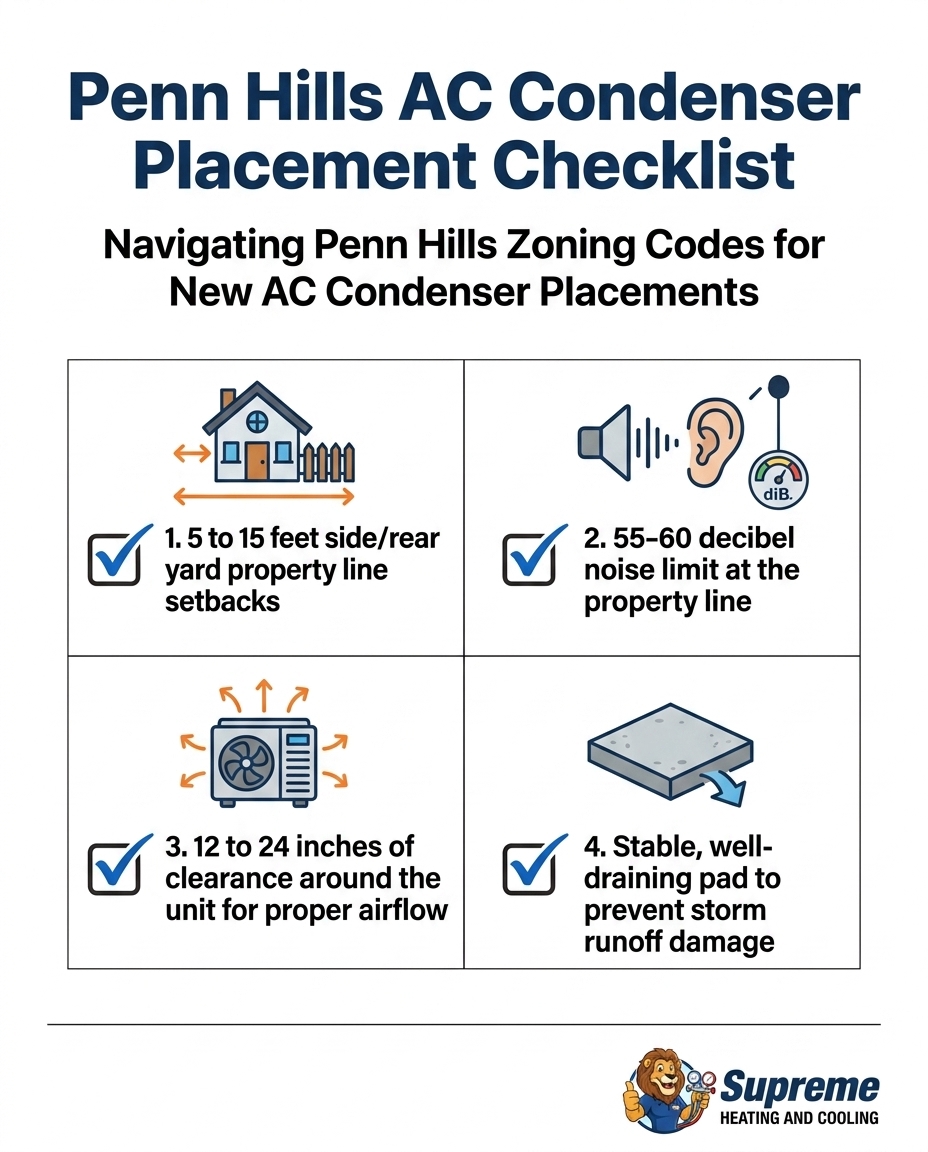
Depending on your exact zoning classification in Penn Hills—such as R-1 or R-2 residential districts—these setbacks typically range from 5 to 15 feet. Side yard setbacks are often different from rear yard setbacks, and corner lots carry their own unique set of rules. Municipalities enforce these distances for several highly practical reasons. They prevent property line disputes between neighbors, maintain neighborhood aesthetics, ensure emergency personnel have clear access to backyards, and prevent excessive noise from bleeding into adjacent properties.
Understanding R-1 and R-2 Zoning Variances
Before you commit to a location for your new condenser, you must verify your exact zoning district. A placement that is perfectly legal for a house three streets over might be a direct violation on your specific lot.
• Side Yard Setbacks — Typical Restriction Impact: Often requires 5 to 10 feet of clearance from the boundary. — Why It Matters for AC Placement: Prevents placing large condensers in narrow walkways between homes.
• Rear Yard Setbacks — Typical Restriction Impact: Can require up to 15 feet of clearance from the back fence. — Why It Matters for AC Placement: Impacts deep lots where homeowners want to hide units far from the patio.
• Corner Lot Rules — Typical Restriction Impact: Treats the street-facing side yard as a secondary front yard. — Why It Matters for AC Placement: Often prohibits mechanical equipment entirely on the street-facing side.
• Easements — Typical Restriction Impact: Utility rights-of-way that cannot be blocked. — Why It Matters for AC Placement: Pouring a condenser pad over an easement can result in forced removal.
Recently, our Supreme Heating and Cooling technicians worked with a local homeowner who had concerns about an aging, inefficient AC unit failing during a peak summer heatwave. They needed the best replacement option for their specific lot size. After listening carefully to their concerns regarding tight property lines and proximity to a neighboring driveway, our team completed a meticulous, professional installation. By verifying the setback rules first, we recommended a unit that perfectly fit the legal footprint while delivering maximum cooling power.
Navigating Residential Noise Ordinances and Decibel Limits
Physical distance is only half the battle when dealing with municipal codes. Residential noise ordinances heavily restrict sustained sound levels to prevent nuisance complaints in quiet neighborhoods. Air conditioning condensers generate steady, sustained noise while running, which means they fall directly under these local noise control laws.
Our team routinely measures these levels, and in most residential areas, noise ordinances cap sustained sound at the property line at around 55 to 60 decibels. To put that in perspective, 60 decibels is roughly the volume of a normal conversational voice or background restaurant chatter. While that does not sound extremely loud, a low-frequency hum running continuously through the night can easily trigger a noise complaint from a neighbor whose bedroom window is just a few feet away.
How Sound Is Measured at the Property Line
The most critical detail homeowners miss is how this noise is legally measured. The decibel limit is not measured right next to the machine; it is measured at the physical property line. This makes the placement of the unit incredibly important.
• The Inverse Square Law: Sound dissipates over distance. A unit placed centrally in your backyard will register much quieter at the fence line than a unit placed just two feet away from the boundary.
• Reflective Surfaces: Placing a condenser in a narrow alley between two brick houses will amplify the sound, causing it to echo and potentially exceed legal limits.
• Equipment Age: Older units with worn compressor bearings routinely exceed 70 decibels, making them a high risk for noise violations.
• Variable-Speed Technology: Modern, variable-speed condensers often run at much lower capacities, keeping decibel levels well below municipal limits while maintaining indoor comfort.
Selecting the right equipment is just as important as selecting the right location. By choosing a modern system designed for quiet operation, you can easily meet property line setback distances and noise decibel limits without sacrificing cooling power.
Balancing Legal Compliance with Peak Cooling Efficiency
A common pattern our installers at Supreme Heating and Cooling see is the conflict between legal compliance and mechanical performance. Homeowners naturally want to hide their outdoor equipment. The instinct is to tuck the condenser behind a large bush, shove it tight against a privacy fence, or build a decorative enclosure around it to meet aesthetic preferences or setback rules. However, this instinct directly contradicts how an air conditioner actually works.
Your outdoor condenser needs to breathe. It works by pulling ambient air across its internal coils to release the heat it absorbed from inside your house. Manufacturer guidelines strictly require a minimum of 12 to 24 inches of unobstructed clearance around the entire unit, and up to 60 inches of vertical clearance above it, to guarantee proper airflow.
The Thermodynamics of Restricted Airflow
When you restrict airflow by placing the unit too close to a fence or wall, the system ends up recycling its own exhausted hot air. During peak July heat, when temperatures soar and the system is under maximum load, this restricted airflow causes the compressor to overwork. The unit will draw significantly more electricity, struggle to cool your home, and suffer unnecessary wear and tear on its internal components.
Finding the placement sweet spot means satisfying both the local zoning inspector and the manufacturer's physical specifications. You must find a location that is far enough from the property line to be legal, yet open enough to allow massive volumes of air to circulate freely. Taking the time to ensure proper AC installation prevents you from accidentally suffocating your new system just to appease a zoning map.
Site Preparation: Managing Summer Storm Runoff and Pad Stability
Once you have identified a location that meets setback rules and airflow requirements, you must evaluate the physical ground itself. The terrain and weather patterns in our region dictate exactly how a condenser pad should be prepared and poured. You cannot simply lay a plastic pad on bare dirt and expect the unit to survive for fifteen years.
Heavy Pennsylvania summer storm runoff poses a significant threat to outdoor mechanical equipment. Sudden, torrential downpours can turn a slightly sloped backyard into a temporary river. If your condenser is placed in a low-lying area or at the bottom of a drainage path, standing water can quickly corrode the base of the unit, damage electrical connections, and cause the metal housing to rust prematurely.
Building a Foundation That Survives Pennsylvania Weather
In our years of preparing sites across Pennsylvania, we've learned that proper pad drainage is an absolute necessity. Furthermore, natural soil settling and heavy summer precipitation can cause the ground to heave and shift. If the soil beneath the condenser pad is not properly compacted and graded, the pad will eventually sink unevenly.
1. Evaluating the Grade: Our installation experts ensure the ground is graded away from the house foundation so water flows past the condenser, not into it.
2. Establishing a Base: We prepare a deep layer of compacted gravel before the pad is placed, promoting rapid drainage during heavy summer storms.
3. Selecting the Pad: Whether utilizing a pre-formed composite pad or a custom concrete base, our team guarantees it is perfectly level.
4. Checking for Settling: We identify and avoid areas prone to severe soil erosion or structural shifting to keep the unit stable over its lifespan.
Connecting physical site preparation back to long-term system reliability is a step that cannot be skipped. A perfectly level unit ensures that the internal compressor oils circulate properly, preventing catastrophic mechanical failures down the road while keeping you fully compliant with local building codes.
The Hidden Risks of Unpermitted Mechanical Installations
It is tempting to bypass the red tape. Dealing with municipal offices, submitting site plans, and waiting for approvals takes time. However, skipping the permit process for new mechanical equipment in Pennsylvania is one of the most expensive mistakes a homeowner can make. Permits are not just a way for the city to collect fees; they are a formal record that your installation meets all safety, electrical, and zoning requirements.
When our team is called in to correct an unpermitted AC condenser installation, we see firsthand that the homeowner has assumed all the legal and financial risk. If a neighbor complains about the noise or notices the unit looks too close to the fence, a municipal inspector will be dispatched to your property. If they find an unpermitted unit, the consequences are immediate and severe.
The Real Cost of Skipping the Paperwork
The risks of non-compliance go far beyond a simple warning letter. Guessing on property lines or noise limits is a financial risk that can cost a substantial amount to correct.
Municipal Fines: Cities can and will levy heavy daily fines for unpermitted work until the situation is rectified. These fines compound quickly and can result in liens against your property.
Forced Relocation: If the unit violates a setback or an easement, you will be legally forced to disconnect the system, pour a new pad in a compliant location, extend all the electrical wiring and refrigerant lines, and reinstall the unit. You pay for the installation twice.
Voided Warranties: HVAC manufacturers explicitly state that equipment must be installed according to local building codes by licensed professionals. An unpermitted, non-compliant installation gives the manufacturer grounds to completely void your 10-year parts warranty.
Real Estate Complications: When it comes time to sell your home, unpermitted mechanical work will be flagged during the buyer's inspection, potentially derailing the sale or forcing you to retroactively pull permits and pay penalties.
Streamlining Your Project with Local Compliance Experts
Navigating zoning maps, filling out permit applications, and calculating decibel limits is overwhelming for the average homeowner. You already have enough on your plate without having to decipher municipal codebooks or measure property lines with a tape measure. This is exactly why relying on our local team at Supreme Heating and Cooling is the smartest approach to a major home upgrade.
In one recent case during a peak July heatwave, a homeowner dealing with a sudden cooling failure called us for guidance on a challenging lot layout. Our Supreme Heating and Cooling technicians recommended a specific unit that fit both the strict property constraints and the home's high cooling demands. The result was a neat, professional installation completed by our knowledgeable team who respected both the property and the local codes.
What Full-Service Compliance Looks Like
Working with a professional team ensures that the installation is not just mechanically sound, but strictly adheres to all municipal regulations. Supreme Heating and Cooling handles all municipal zoning, setback, and permit requirements for Penn Hills homeowners to guarantee a compliant installation. You do not have to worry about drawing site plans or arguing with inspectors.
There is a distinct peace of mind that comes from having experts handle the entire process, from pulling the initial permits to executing the final cleanup. Professional management guarantees a completely hassle-free and legally sound installation, allowing you to focus on enjoying a cool, comfortable home rather than stressing over zoning maps.
If you need reliable Penn Hills air conditioning services, choosing a contractor who understands the local bureaucratic landscape is just as important as choosing one who understands refrigerant pressures.
Take the Guesswork Out of Your Next HVAC Project
Balancing property line setbacks, noise decibel limits, and manufacturer airflow clearances is critical for a successful, long-lasting AC installation. Navigating Penn Hills zoning codes for new AC condenser placements does not have to be a source of stress when you have the right information. Having a clear, authoritative understanding of these requirements gives you the confidence to finalize your installation plans without fear of municipal fines or voided warranties.
At Supreme Heating and Cooling, we believe you deserve a cooling system that runs efficiently, quietly, and entirely within the bounds of local regulations. If you are ready to upgrade your home's comfort, reach out to schedule a consultation to review your specific property layout and find the perfect, legally compliant spot for your new equipment.
Frequently Asked Questions
How close to the property line can I put my AC unit in Penn Hills?
In our experience, standard residential zoning generally requires a setback of 5 to 15 feet from the property line, depending on whether it is a side or rear yard. You must verify your specific R-1 or R-2 zoning district rules, as placing the unit too close can result in code violations and forced relocation.
Do I need a permit to install a new AC in PA?
Yes, installing new mechanical equipment requires a permit in most Pennsylvania municipalities. Pulling a permit ensures the installation meets all electrical, safety, and zoning codes, protecting you from fines and ensuring your manufacturer warranty remains valid.
What is the residential noise limit for AC units?
Most residential noise ordinances cap sustained sound at the property line at around 55 to 60 decibels. Because sound is measured at the boundary line, placing a loud unit too close to a neighbor's fence can easily trigger a noise violation.
Can I move my AC condenser to the side of my house?
You can move the condenser to the side of your house only if that location meets both the municipal side yard setback requirements and the manufacturer's airflow clearances. Side yards are often narrow, making it difficult to maintain the necessary 12 to 24 inches of airflow space while staying legally away from the property line.
What happens if my existing AC unit violates current zoning codes?
Existing units that were installed legally under older codes are typically grandfathered in and do not require immediate relocation. However, when you replace that old unit with a new one, the new installation must comply with all current, updated zoning regulations.
How much clearance does an outdoor AC unit need for proper airflow?
Manufacturers require a minimum of 12 to 24 inches of completely unobstructed horizontal clearance around the entire unit, and up to 60 inches of vertical clearance above it. Restricting this airflow causes the system to overwork, drastically reducing cooling efficiency and shortening the lifespan of the compressor.
Other Blogs
Promotions
Take advantage of our latest promotions to save on chimney, dryer vent, and air duct cleaning—making it easier to protect your home and improve air quality at a great value.
10% off for veterans, law enforcement, and first responders


Customer Testimonials
Our customers love the noticeable difference in air quality, the professionalism of our team, and the peace of mind that comes with every thorough cleaning.


Copyright © 2025 Superior Vents. All rights reserved.
Designed & Developed by
