

Is Your AC Running Constantly? When to Worry About Continuous Cycling
A system that won't shut off during peak heat isn't always broken. Find out how to distinguish normal design-temperature operation from a failing AC unit.
Why Won't My Air Conditioner Shut Off?
Is your AC running constantly? When to worry about continuous cycling is a question that plagues many homeowners when the afternoon heat hits its peak. At Supreme Heating and Cooling, it is one of the most common concerns we hear from PA residents during the dog days of July. You hear the compressor humming outside hour after hour, and the immediate fear sets in: is the system about to break down, or are you looking at an astronomical utility bill? The central decision point is determining whether your system is simply working exactly as designed to handle a massive heat load, or if it is struggling against a mechanical failure that requires immediate intervention. Hearing your air conditioning run non-stop during a heatwave can induce panic, but it is not always a crisis.
For homeowners trying to decide whether to let the system run or shut it down, understanding the difference between standard operation and a critical failure is essential. If you need immediate help evaluating your system, learn more about our air conditioning services.
Understanding HVAC Design Temperature and Cooling Cycles
To understand why an air conditioner might run without stopping, you first need to understand how these systems are engineered. Heating, ventilation, and air conditioning equipment is sized based on specific metrics, primarily the ASHRAE (American Society of Heating, Refrigerating and Air-Conditioning Engineers) design temperature for your specific region. The design temperature is the maximum outdoor temperature a properly sized AC is engineered to handle while keeping the indoor temperature at a comfortable setting (usually around 75 degrees Fahrenheit).
When the outdoor temperature hits or exceeds this design limit during peak-summer conditions, a perfectly sized system is actually supposed to run 100 percent of the time. It is not failing; it is matching the heat gain of your home degree for degree. If the unit were to shut off during these peak conditions, the indoor temperature would immediately begin to rise.
Many homeowners mistakenly believe that an oversized unit is better because it cools the house rapidly and shuts off. In reality, a unit that is too large for the space will "short-cycle," turning on and off rapidly. This frequent starting and stopping consumes significantly more electricity, wears out the compressor prematurely, and fails to properly dehumidify the air. A correctly sized unit running continuously on the hottest day of the year is operating exactly as the engineers intended.
How Long Should an AC Cycle Last?
Under moderate weather conditions, standard cooling cycles typically last between 15 and 20 minutes. The system turns on, removes the heat and humidity, reaches the thermostat setting, and shuts down to rest. However, as the outdoor temperature climbs, these cycles naturally stretch out. During a severe heatwave, a cycle might extend to 45 minutes, an hour, or even run continuously until the sun goes down and the outdoor temperature drops. As long as the indoor temperature is holding steady, this extended cycle length does not damage the equipment.
Sensible Cooling vs. Latent Cooling: The Humidity Factor
Temperature is only one half of the comfort equation. Air conditioners actually perform two distinct jobs simultaneously: lowering the air temperature (sensible cooling) and removing moisture from the indoor air (latent cooling). Understanding the difference between these two functions is critical when evaluating why your system seems to be running non-stop.
Removing moisture from the air is a slow, gradual process. As warm indoor air passes over the freezing cold evaporator coil, the moisture in the air condenses into water droplets, drips into the condensate drain pan, and is channeled outside. This physical process takes time. If an air conditioner shuts off too quickly, it might successfully lower the temperature (satisfying the sensible cooling load), but it will leave the moisture behind. The result is a home that feels cold but incredibly clammy and uncomfortable.
This is especially relevant in the Pittsburgh area. With a hot summer climate where relative humidity frequently exceeds 70 percent, the latent cooling load is massive. In our experience keeping local homes comfortable through peak-summer heat waves, we consistently see that your air conditioner has to work much harder to wring that heavy moisture out of the air before you actually feel comfortable. Because of this high humidity, longer AC cycles are an absolute necessity for indoor comfort during peak-summer months. The system is intentionally running longer to dehumidify the space, ensuring that the air inside feels crisp and dry rather than stagnant and damp.
Signs Your System is Just Working Hard (When NOT to Worry)
Before you rush to the thermostat in a panic, take a moment to evaluate the actual performance of the system. If you search "Is Your AC Running Constantly?" online, you will find a lot of conflicting information. The most reliable way to tell if your system is just managing a heavy heat load is to check for a few specific indicators of healthy operation.
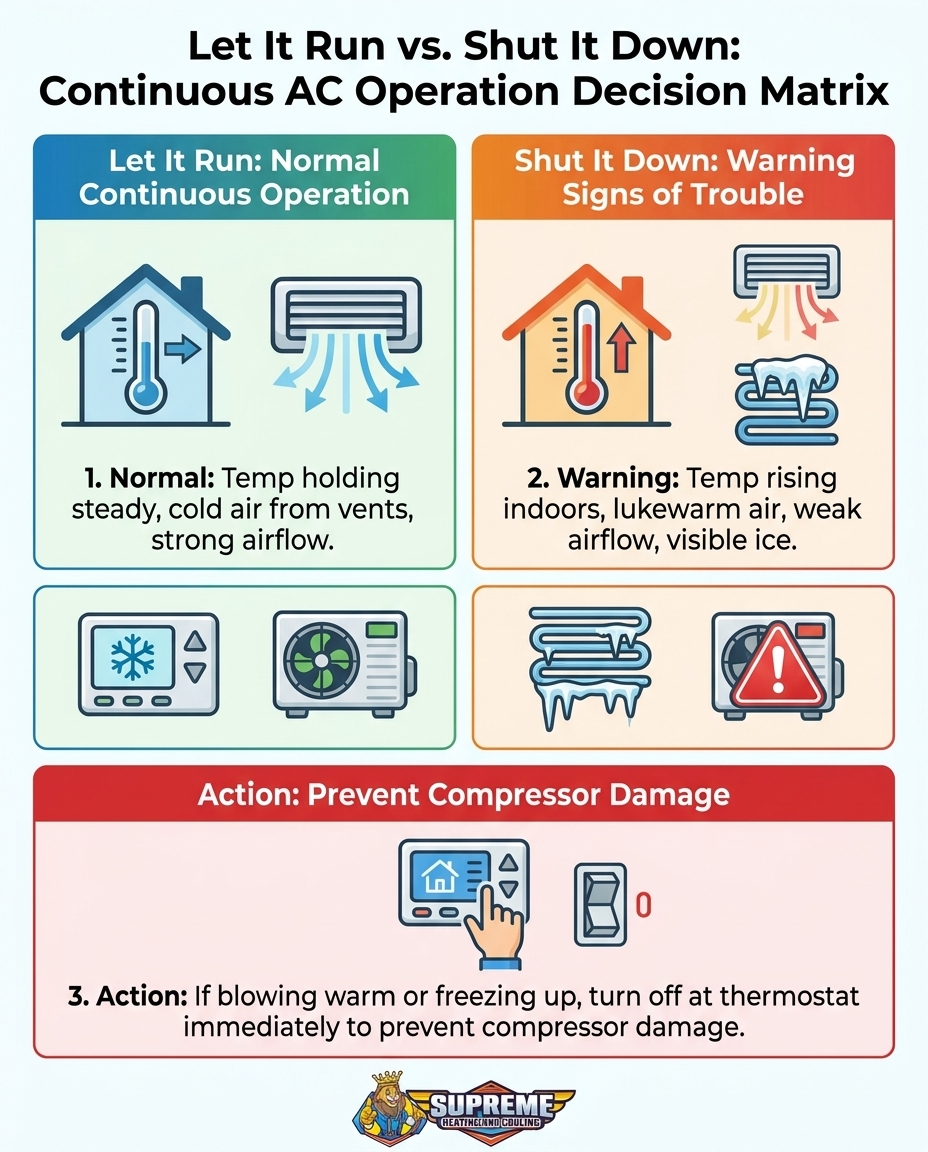
• The indoor temperature is holding steady: Even if the system is running constantly, check the thermostat. If the indoor temperature is holding at or very close to your set temperature during the hottest part of the afternoon, the system is successfully keeping up with the heat gain.
• The air from the vents feels noticeably cold: Hold your hand up to a supply vent. The air blowing out should feel crisp and significantly colder than the room temperature air.
• Airflow is strong and consistent: You should feel a robust push of air coming from the vents in every room, indicating that the blower motor is operating correctly and there are no severe restrictions.
• The system cycles off in the evening: Once the sun goes down and the outdoor ambient temperature drops, the heat load on your home decreases. A healthy system will eventually satisfy the thermostat and cycle off naturally during the evening or overnight hours.
If your system meets all of these criteria, it is likely just working hard to combat extreme outdoor conditions. Let it run, keep your doors and windows closed, and monitor the situation.
Warning Signs That Demand Immediate Attention
While continuous operation can be normal under extreme conditions, there are undeniable symptoms that indicate a mechanical failure. If your system is running non-stop but failing to condition the space, allowing it to continue running can cause severe, sometimes irreversible damage to the compressor. You need to know exactly when to step in.
• Indoor temperature steadily rising — What It Usually Means: The system has lost its cooling capacity due to a refrigerant leak or compressor issue.
• Lukewarm or room-temperature air — What It Usually Means: The refrigerant cycle has stopped absorbing heat, or the outdoor condenser is failing.
• Visible ice on the indoor coil or outdoor lines — What It Usually Means: Severe airflow restriction or low refrigerant is causing the condensation to freeze solid.
• Weak or barely noticeable airflow — What It Usually Means: The blower motor is failing, or the evaporator coil is completely blocked by ice or dirt.
• Unusual hissing, bubbling, or grinding noises — What It Usually Means: Hissing indicates a high-pressure refrigerant leak; grinding points to motor bearing failure.
When Should I Turn Off My AC?
The definitive rule for homeowners is this: if the system is blowing warm air, or if you see visible ice forming anywhere on the indoor or outdoor unit, turn the system off immediately at the thermostat. Do not wait to see if it gets better. Continuing to run a failing system—especially one that is frozen—can permanently damage the compressor, leading to a massive repair bill. If you notice these symptoms during peak-summer heat, shut the system down at the thermostat and investigate why your AC is blowing warm air before taking further action.
Common Culprits Behind an Overworked AC
When an air conditioner runs constantly but fails to actually cool the home, there is usually a specific mechanical or maintenance issue forcing the continuous cycle. Identifying these culprits early can save your system from a total breakdown. If you are constantly asking "Is Your AC Running Constantly?" while sweating in your living room, one of these four issues is likely to blame.
1. Dirty Air Filters: This is the most common and easily preventable issue. A clogged air filter severely restricts the amount of warm air the blower motor can pull into the system. Without enough warm air passing over the cold evaporator coil, the system runs longer to compensate. Eventually, the lack of airflow causes the coil to drop below freezing, turning the condensation into a solid block of ice.
2. Low Refrigerant Levels: Air conditioners do not consume refrigerant like a car consumes gas. If the system is low on refrigerant, there is a leak somewhere in the closed loop. When refrigerant is low, the system cannot absorb enough heat from the indoor air, forcing it to run continuously in a futile attempt to reach the target temperature.
3. Dirty Condenser Coils: The outdoor unit's primary job is to release the heat absorbed from inside your home into the outside air. If the aluminum fins on the outdoor coil are caked in mud, grass clippings, or cottonwood seeds, the heat remains trapped. The system will run non-stop trying to push heat out through a blocked barrier.
4. Malfunctioning Thermostats: Sometimes the cooling equipment is working perfectly, but the brain of the operation is failing. A malfunctioning thermostat might fail to register that the room has reached the target temperature, meaning it never sends the electronic signal telling the system to shut off.
Addressing these issues quickly is vital. Our team at Supreme Heating and Cooling recently responded to a local homeowner during a blistering hot summer day when their AC stopped working entirely after a long period of continuous strain. One of our technicians was dispatched quickly, identified the underlying restriction, and had the system back up and running within 30 minutes. This highlights why staying on top of preventative AC maintenance is so critical to preventing mid-season breakdowns.
The Importance of Professional AC Diagnostics
While changing an air filter is a great DIY step that every homeowner should handle monthly, diagnosing continuous running combined with poor cooling requires specialized tools, professional gauges, and EPA licensing. When an air conditioner is struggling, guessing at the problem often leads to expensive mistakes.
In our years of restoring cooling performance across PA, we have seen firsthand that one of the biggest dangers to an HVAC system is the application of "band-aid" fixes. For example, simply topping off a system with fresh refrigerant without taking the time to locate and repair the underlying leak guarantees that the system will fail again—usually on the hottest day of the year. Furthermore, running a system with incorrect refrigerant charges places massive strain on the compressor, shortening its lifespan significantly.
At Supreme Heating and Cooling, our expert technicians provide precise diagnostics to identify the true root causes of continuous cycling, ensuring long-term reliability rather than temporary fixes. A comprehensive system evaluation involves checking the electrical draw of the motors, measuring the superheat and subcooling of the refrigerant, and verifying that the airflow matches the manufacturer's specifications. If your system is showing signs of distress during peak-summer conditions, relying on emergency AC services ensures that the real problem is solved safely and effectively.
Frequently Asked Questions About Continuous AC Cycling
Is it bad if my AC runs continuously?
It is not inherently bad if your AC runs continuously during extreme heat, provided the indoor temperature is holding steady and the air coming from the vents is cold. A properly sized system is designed to run 100 percent of the time when outdoor temperatures reach the local design limit. However, if it runs constantly while blowing warm air, that is a sign of mechanical failure.
How many hours a day should an AC run?
During moderate summer weather, a healthy AC might run for a total of 8 to 12 hours a day, broken up into 15 to 20-minute cycles. During a severe heatwave, that total run time can easily climb to 16 hours or more. The total daily run time depends entirely on the outdoor temperature, the home's insulation, and the thermostat setting.
Why won't my AC shut off even when the house is cool?
If the house has reached the target temperature but the system refuses to shut down, the most likely culprit is a malfunctioning thermostat or a stuck contactor relay in the outdoor unit. The thermostat may be failing to send the "stop" signal, or the electrical relay outside has fused shut, forcing the compressor to keep running. This requires a professional electrical repair.
Does running the AC constantly damage it?
Running constantly under normal heavy-load conditions does not damage a well-maintained AC, as the internal components are designed for continuous duty. However, if the system is running constantly because of a dirty filter, low refrigerant, or a frozen coil, the resulting strain will overheat the compressor motor and cause permanent damage.
Is it normal for my AC to run constantly on hot days?
Yes, it is completely normal for an air conditioner to run constantly on exceptionally hot days. If you find yourself asking "Is Your AC Running Constantly?" during an afternoon where temperatures are breaking local records, verify that the air is cold and the indoor temperature is stable. If both are true, the system is simply doing its job.
How do I know if my continuous AC cycling is caused by high humidity?
If your AC is running long cycles but the air coming out of the vents is cold and the indoor temperature is slowly dropping, it is likely tackling a high latent heat load (humidity). You will often notice that the home feels much more comfortable and less sticky after these long cycles, as the system has successfully pulled the heavy moisture out of the indoor air.
Restore Your Home's Comfort and Efficiency
True peace of mind comes from knowing exactly whether your cooling system is just working hard against peak-summer heat or crying out for professional help. By understanding the difference between normal heavy-load operation and the undeniable warning signs of mechanical failure, you can protect your equipment from severe damage. If you have noticed rising indoor temperatures, weak airflow, or warm air coming from your vents, do not wait for the system to fail completely. Turn it off, protect your compressor, and schedule professional AC repair in Pittsburgh to get a clear, actionable breakdown of the problem and restore your home's comfort.
Other Blogs
Promotions
Take advantage of our latest promotions to save on chimney, dryer vent, and air duct cleaning—making it easier to protect your home and improve air quality at a great value.
10% off for veterans, law enforcement, and first responders

Customer Testimonials
Our customers love the noticeable difference in air quality, the professionalism of our team, and the peace of mind that comes with every thorough cleaning.


Copyright © 2025 Superior Vents. All rights reserved.
Designed & Developed by
